Search models, users, collections, and posts

Body Fat Caliper - Measure Body Fat Anytime, Anywhere
IP Report
Print Profile(1)

0.16mm layer, 2 walls, 15% infill
Designer
1.7 h
1 plate
Open in Bambu Studio
Boost
19
53
2
0
51
27
Released
Description
Content has been automatically translated.

printing
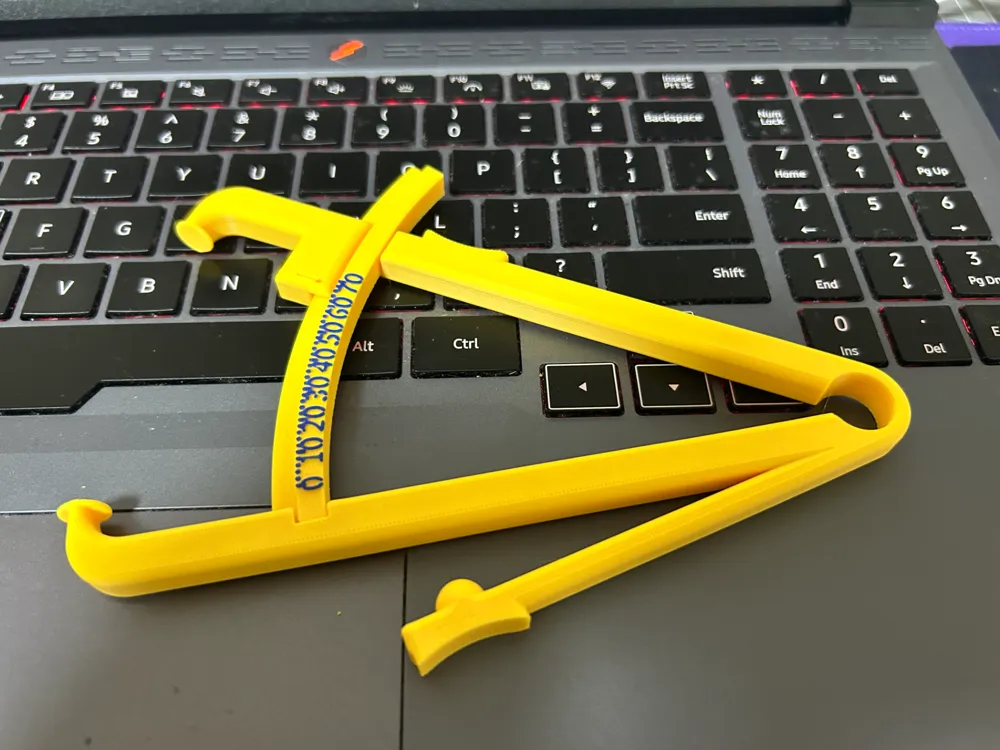
Can be multi-color printed, the scales and numbers are raised, also supports single-color printing To ensure the strength of the connecting part, the overall wall thickness is set to 5 layers, do not modify It is recommended to use materials with higher strength, such as PETG or ABS, PLA has not been tested, durability is uncertainAssembly
Slide the ruler into the grooves of the caliper's two arms, the connection needs to be gluedKey points for use
Pinch the two arc-shaped anti-slip finger grooves when using Do not apply excessive force when pinching, the hemisphere on the bifurcated side just needs to touch the caliper arm The readings are for reference only and have no medical significanceBoost Me (for free)
Thank you for your support!
How to use a body fat caliper
A body fat caliper, also known as a skinfold caliper, is a tool for estimating whole-body fat percentage by measuring the thickness of subcutaneous fat in specific parts of the body. Compared to expensive professional equipment, it is affordable and portable, a practical choice for home fitness enthusiasts to monitor changes in body composition Core principle: The body's subcutaneous fat has a certain proportional relationship with total fat. By measuring the thickness of skinfolds at specific points, the body fat percentage can be estimated by plugging into a formula. Although its absolute value may not be as accurate as professional equipment like DEXA scans, it is very reliable for tracking changes in fat trends in the same person at different timesHow to use a body fat caliper for measurement? (Seven-step method)
Important note: To ensure the accuracy and comparability of measurement results, please try to keep the measurement conditions consistent (for example, always in the morning on an empty stomach, after drinking water, and measured by the same person)Step one: Prepare tools and body
- Tools: body fat caliper, pen, measurement record sheet
- Body: Do not engage in strenuous exercise before measurement, keep the body relaxed. Expose the parts to be measured
Step two: Find the correct measurement sites (common three-site method/Jackson & Pollock method)
This is the most commonly used method and suitable for home operation. The three sites differ for men and women:- Men: chest, abdomen, thigh
- Women: triceps, abdomen, thigh
- Triceps (women):
- Arm hanging naturally, find the midpoint between the acromion (highest point of the shoulder) and the olecranon (protrusion of the elbow)
- At the midpoint, pinch a skinfold longitudinally along the arm
- Chest (men):
- Located at the midpoint between the nipple and the anterior axillary fold (crease at the front of the pectoralis muscle and shoulder)
- The skinfold direction is diagonal, consistent with the direction of the pectoralis muscle
- Abdomen (men and women):
- Approximately 2-3 cm to the right of the navel
- Pinch a skinfold longitudinally
- Thigh (men and women):
- Front of the thigh, midpoint between the top of the thigh and the upper edge of the kneecap
- Pinch a skinfold longitudinally
Step three: Correctly pinch the skinfold
This is the most critical step, directly affecting the results!- Use your thumb and forefinger to pinch the skin and subcutaneous fat at the measurement point, make sure to pinch only the skin layer, not including the underlying muscle
- After pinching, gently lift to separate the skinfold from the underlying muscle
Step four: Place the body fat caliper and take readings
- Place the jaws of the body fat caliper below the pinched skinfold, approximately 1 cm away from your fingers
- Slowly release the grip of the body fat caliper, allowing the jaws to fully clamp the skinfold
- Wait 2-3 seconds, after the pointer stabilizes, read the value. The unit is millimeters (mm)
- Record the reading
Step five: Repeat measurements for accuracy
- Measure 2-3 times consecutively at each site
- If several readings differ significantly (more than 1-2mm), re-measurement is required
- Take the average value of several readings as the final skinfold thickness for that site
Step six: Calculate the sum of the three sites
Add the average values of the three measurement sites to get your total skinfold thickness (unit: mm)- Male sum (S_m) = chest thickness + abdomen thickness + thigh thickness
- Female sum (S_f) = triceps thickness + abdomen thickness + thigh thickness
Step seven: Substitute into the table to calculate body fat percentage
Refer to the table based on your gender, age (row), and total skinfold thickness (column) to obtain the body fat percentage value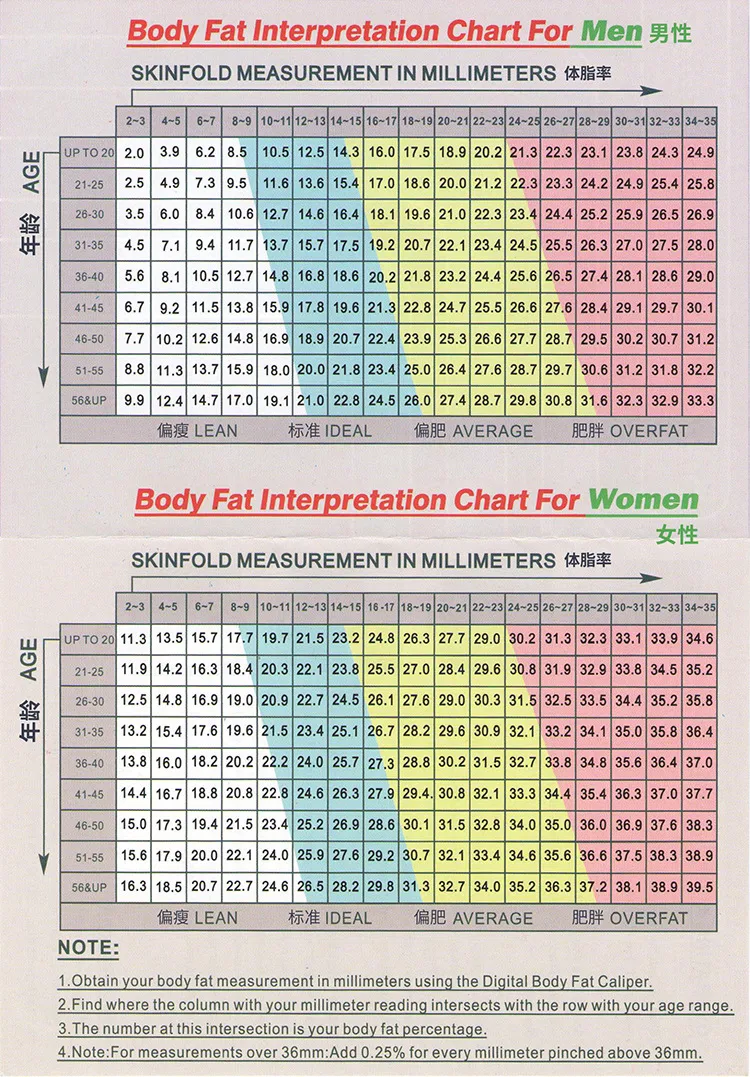
Notes and limitations
- Focus on trends, not absolute values: The greatest value of a body fat caliper lies in tracking changes. As long as the measurement method remains consistent, you can clearly see whether fat is decreasing or increasing. There's no need to over-focus on a specific single reading
- Measurement error: Measurement technique requires practice, and different people may get different measurement results. It's best to always have the same person measure you
- Not suitable for all populations: The estimation error of this method may increase for extremely obese or extremely thin individuals, as well as the elderly
- Supplementary tools: It is recommended to combine body fat caliper data with circumference measurements (waist, hip, etc.) and regular photos to more comprehensively reflect body changes
License

This user content is licensed under a
Creative Commons Attribution-Noncommercial-Share Alike


Comment & Rating (2)