
FlexiDry - desiccant bag
Print Profile(1)
Bill of Materials

Description
Man, sometimes things can be that simple…^^
FlexiDry Desiccant Bag: The Art of 3D-Sewing
Rethinking Filament Care: A Technical Leap
Let's face it: common rigid desiccant casings, though functional, suffer from critical design flaws. They are bulky, have rigid form factors that rarely fit compact spools, and offer inefficient packing volume. Every year, makers fight the same battle against moisture. It’s a recurring frustration in every print lab.
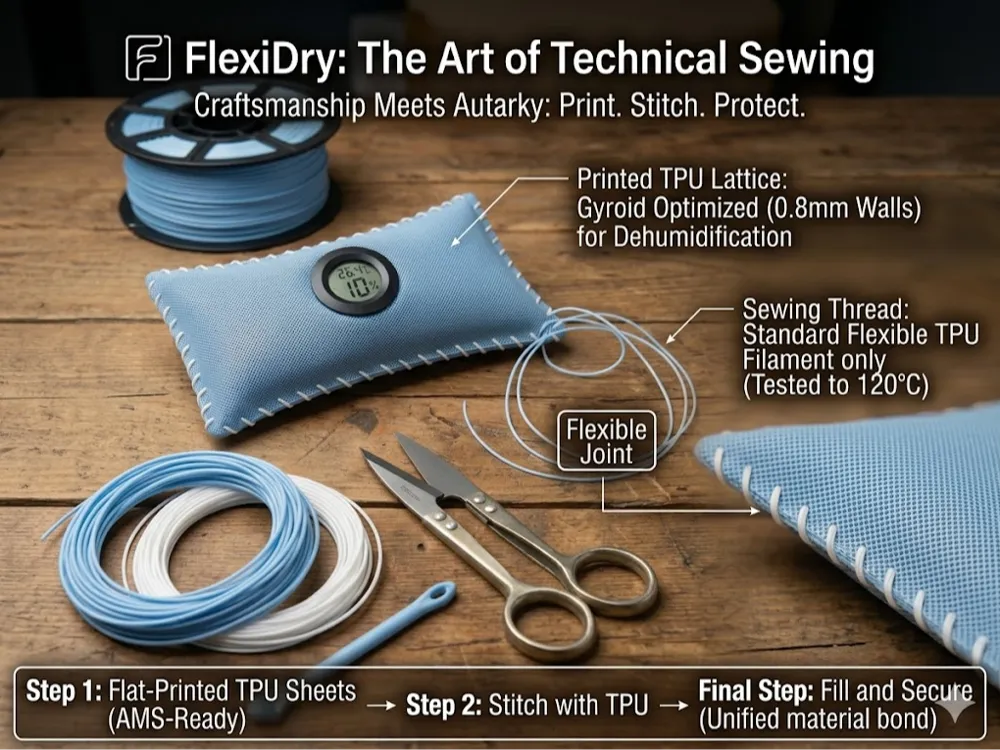
The FlexiDry Desiccant Bag is not just another casing. It is a true proof-of-concept for '3D-Sewing,' a hybrid manufacturing method that merges the precision of additive technology with the tactile, robust elegance of traditional leatherwork. Rather than printing a bulky box, this model generates flat, highly-detailed TPU 'Lattice Sheets' that print with zero supports. The unique assembly technique is the core innovation, activating the final, functional form by 'stitching' the skins together.
The Assembly Concept: Print. Stitch. Protect.
This process transforms a flat-printed sheet into a pliable 3D structure:
- Print (Step 1): Flat sheets of AMS-Ready TPU are printed. They require maximal bed utilization and zero cleanup.
- Stitch (Step 2): Standard flexible TPU Filament is used as the 'sewing thread.' This creates a unified material system (TPU skin to TPU thread), resulting in a high-strength, yet dynamic bond. It is the symbiosis of dynamic flex (the skin) and structural tensile force (the thread).
- Protect (Final Step): Fill with Silica Gel and complete the final seam, creating a secure, heat-resistant seal.
Why Choose FlexiDry? (Technical Advantages)
- Pliable Structure: Unlike rigid casings, the final bag is universally form-fitting, molding itself to the narrowest spool centers, maximize packing efficiency in any environment.
- Unified material bond: The TPS (TPU-on-TPU System) validates structural integrity, tested to 120°C for easy desiccant regeneration (microwave or oven safe).
- Maximized Passive Dehumidification: The lattice structure features 0.8mm Gyroid walls, providing maximum surface area for unhindered air diffusion while preventing bead spill.
Technical Specifications
(Use the detailed table below and pair it with the corresponding visual schematic.)
| Specification | Details |
|---|---|
| Material: Lattice Sheet | TPU (Bambu Lab AMS-Ready or standard recommended) |
| Material: Sewing Thread | Standard TPU Filament (Flexible) |
| Thermal Resistance | Up to 120°C (Silica Gel safe range) |
| Assembly Method | Manual Threading / 3D-Sewing |
| Feature Set | Unified Material bond |
| Capacity | 500g or 1000g Capacity |
| Option | Integrated Hygrometer |
Have fun and,
Regards
License

You shall not share, sub-license, sell, rent, host, transfer, or distribute in any way the digital or 3D printed versions of this object, nor any other derivative work of this object in its digital or physical format (including - but not limited to - remixes of this object, and hosting on other digital platforms). The objects may not be used without permission in any way whatsoever in which you charge money, or collect fees.


Comment & Rating (0)