




Print Profile(1)

Description
Project Idea and Function
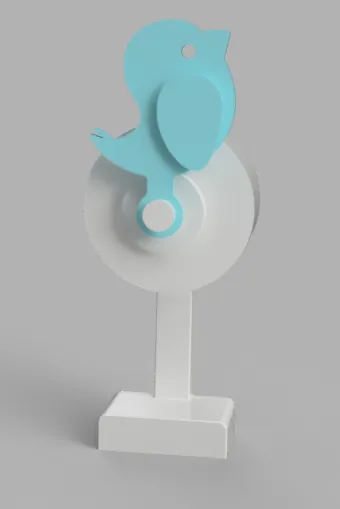
This project is an interactive air quality monitor in the form of a bird, which behaves "alive", "dying", or "dead" on its perch depending on the room air quality. An ESP32‑C3 measures CO₂, VOC, NOx, temperature, humidity, and air pressure, and controls the pose of the printed bird via a servo, thereby drawing attention to critical air conditions.
I was inspired by https://andywarburton.co.uk/2023/make-a-canairi-inspired-smart-air-quality-sensor-using-circuitpython-mqtt-and-homeassistant/ and the "original" Birdie. Since the original's pure CO2 measurement seemed insufficient to me, I installed additional sensors. I also didn't want to do without integration into my smart home with Home Assistant. As I wanted to place the entire setup on my desk, I also needed internal cable routing.
How the System Works
- An SCD4x sensor measures the CO₂ content of the room air, while an SGP4x provides VOC and NOx indices; AHT20 and BMP280 supplement temperature, humidity, and air pressure.
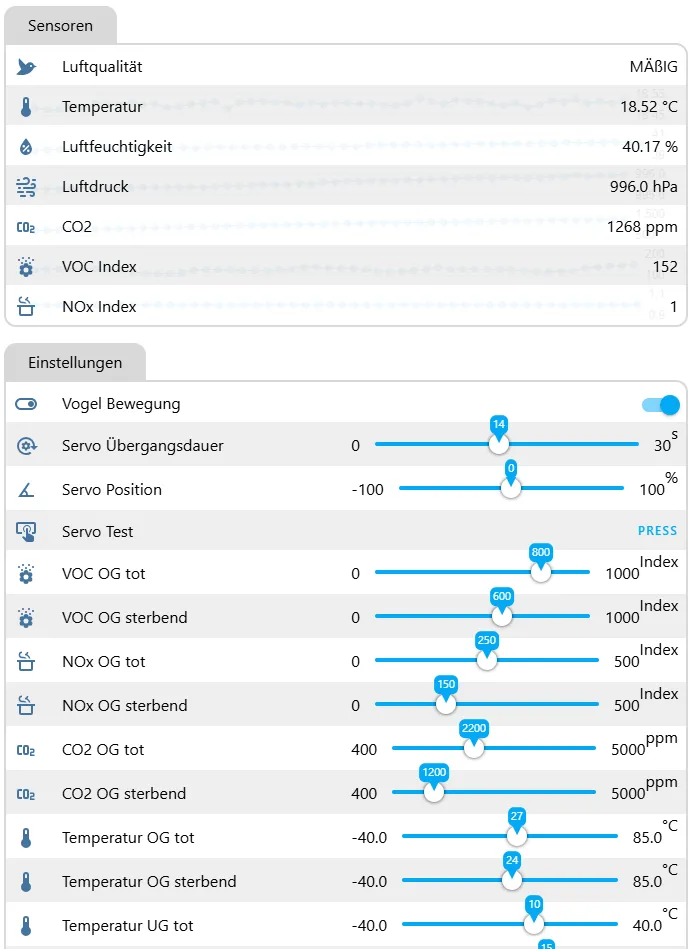
- The measured values are compared in the ESP32‑C3 with adjustable thresholds, and the servo moves to one of the three target angles for "GOOD", "MODERATE", or "BAD", with the transition duration being continuously adjustable.
ESPHome Firmware / Software
- The firmware is entirely based on ESPHome and uses the servo component, several I²C sensors, as well as template sensors and switches.
- All sensor thresholds, servo angles, transition time, and temperature offset can be adjusted and permanently stored via the web interface or integrated into Home Assistant.
Mechanics and 3D Printed Parts
The STL/3MF files contain:
- Bird body with integrated bearing for the servo output shaft.
- Housing or base for ESP32‑C3 board, sensor boards, and cable routing, suitable for a standard micro servo (e.g., SG90 / 9g servo).
- Apart from the motor cover on the housing and the wings on the bird's axis, nothing needs to be glued. This allows other objects to be quickly and easily attached for display.
Electronic Components Used
- ESP32‑C3 Super Mini as the central Wi‑Fi‑enabled microcontroller board.
- SCD4x CO₂ sensor (SCD40/SCD41) for CO₂ measurement in the range of typical indoor concentrations.
- SGP4x (SGP40/SGP41) for detecting VOC and NOx indices for general air pollutants.
- AHT20 (AHT10‑compatible) temperature and humidity sensor.
- BMP280 for air pressure measurement and optional temperature reference.
- Dupont cables for sensor connection.
- 9g servo or comparable RC servo with 5V supply and PWM input (e.g., SG90 type).
- USB-C test board with 5V output.
- 5V power supply (USB power supply) for ESP32‑C3 and servo, sufficiently dimensioned (at least 1A recommended).
- Mounting materials:
- M3 screws and suitable heat-set inserts (4mm) for the housing.
- Double-sided tape to secure the sensors in the housing.
- Optional:
- Weights for the base for a more stable stand
- Rubber feet to stick on to prevent the housing from slipping
Print Profile and Assembly Instructions
- Recommended material: PLA or PETG, as both are sufficiently temperature-resistant and easy to print.
- Wall thickness, infill (e.g., 15–20%), and minimal support structures.
Documentation (1)
This remix is based on

License



Comment & Rating (1)