
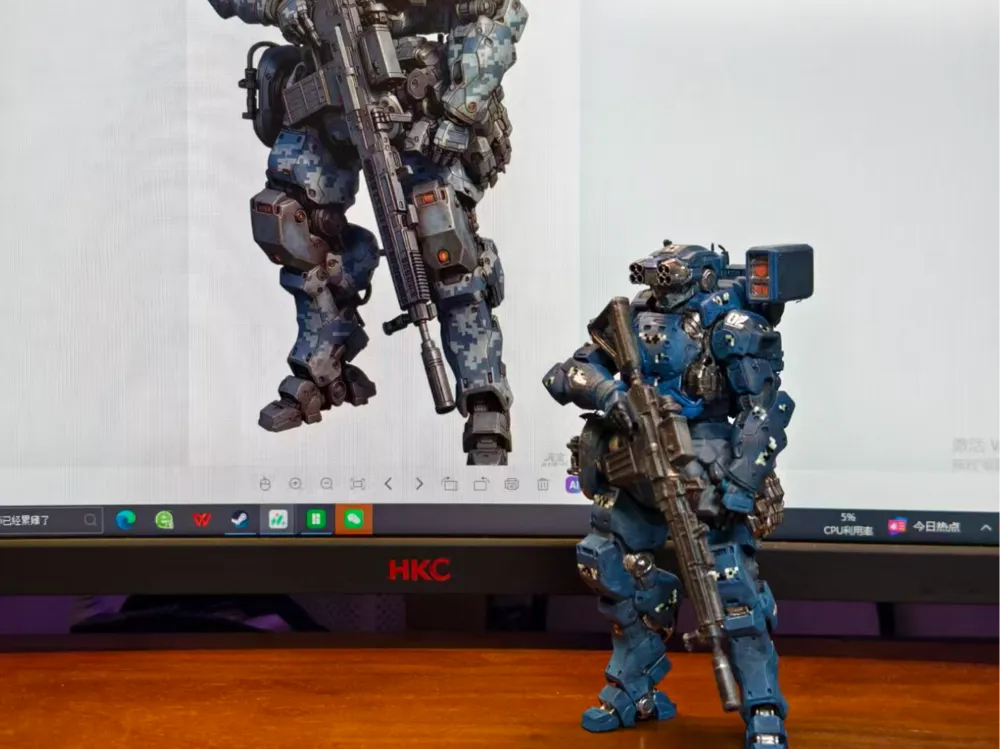
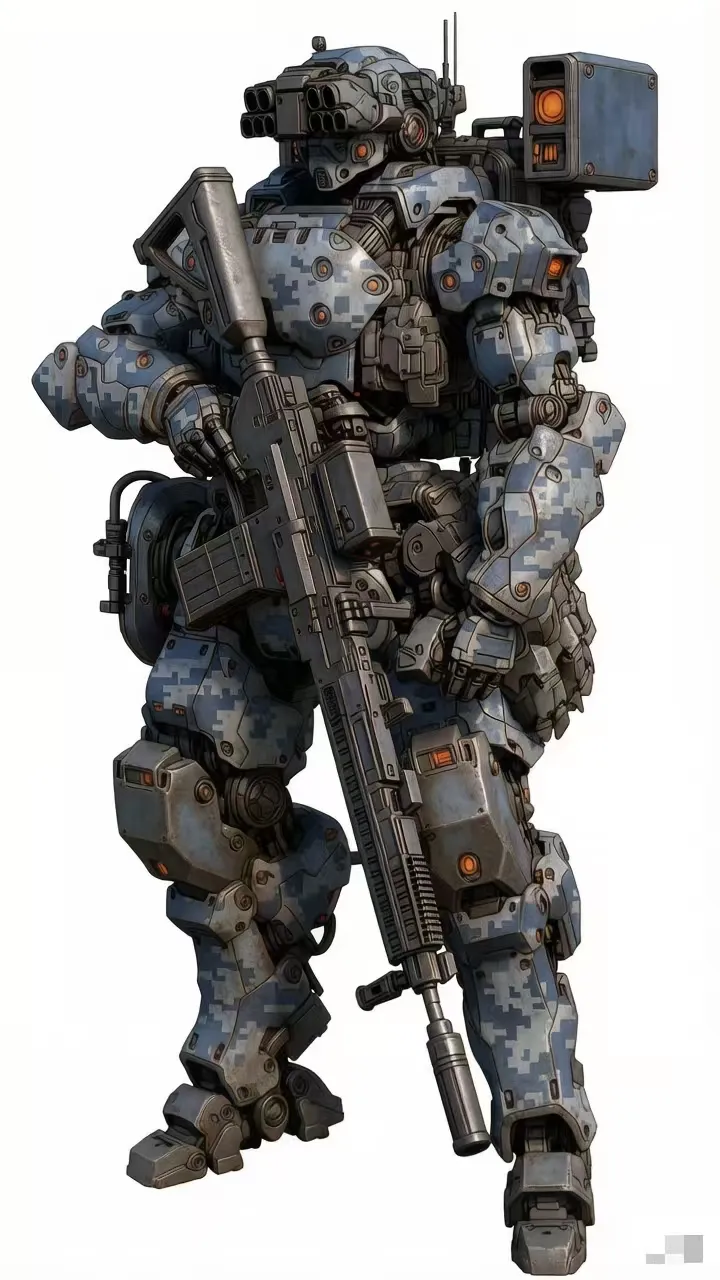
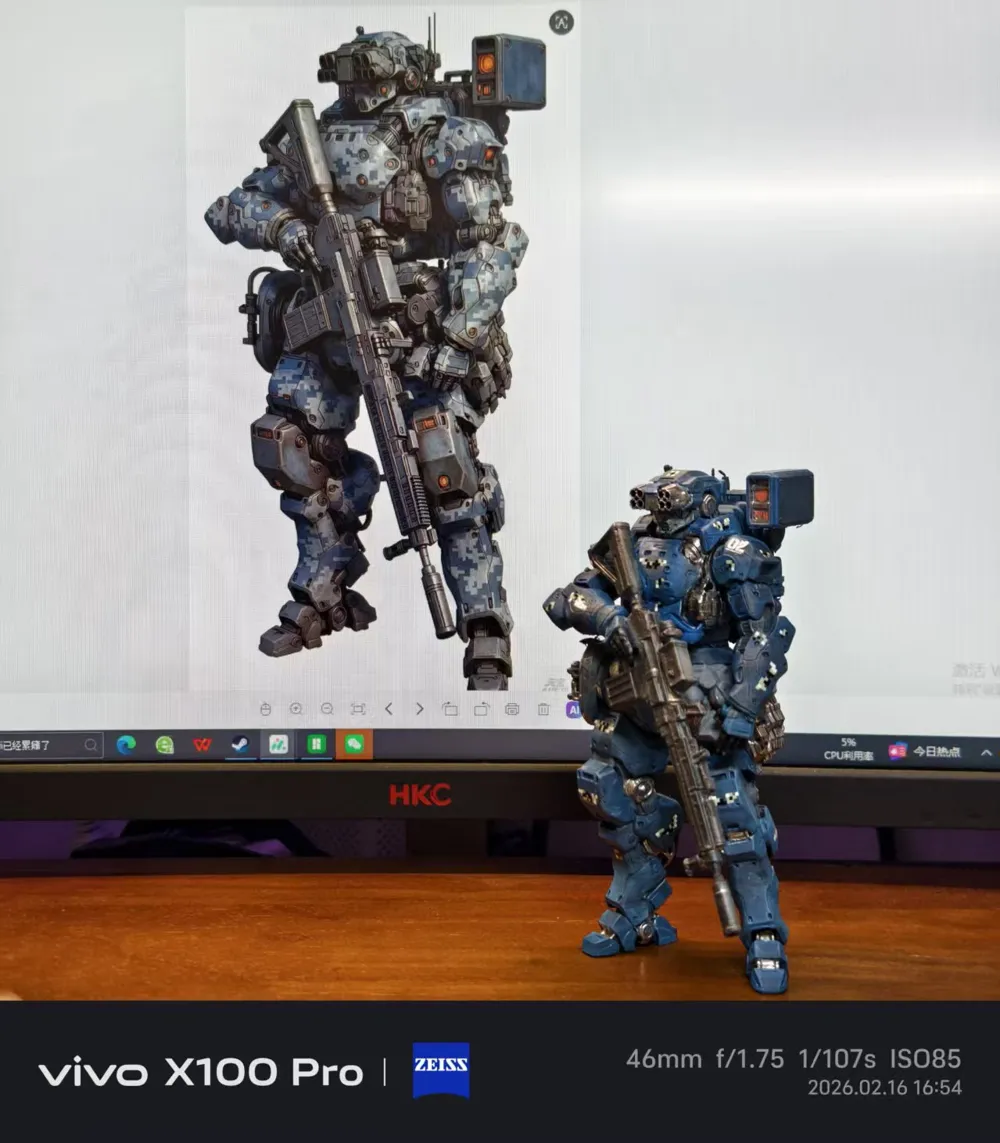
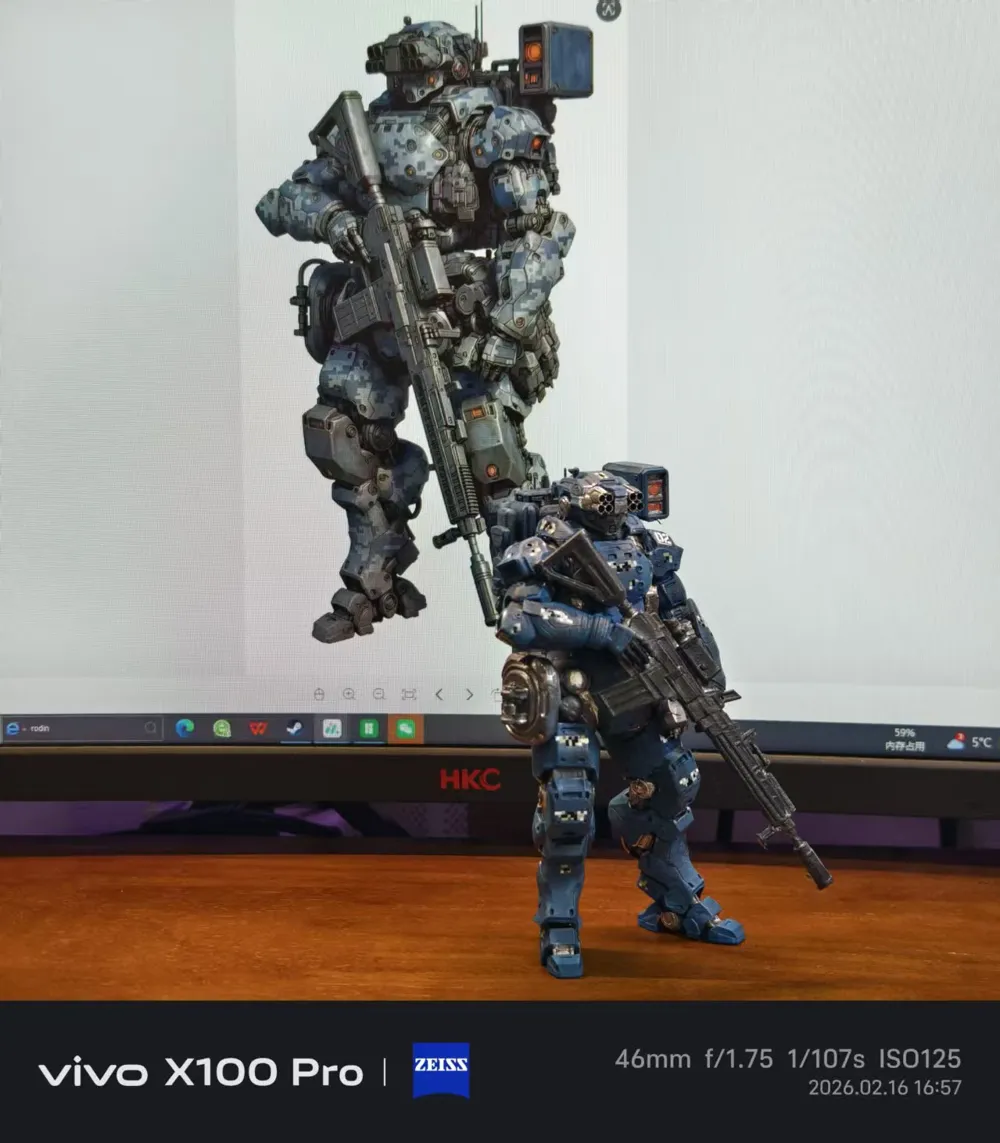
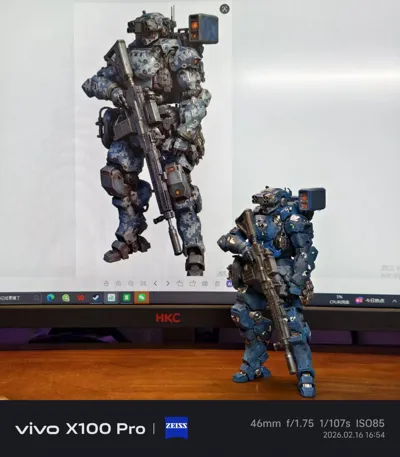
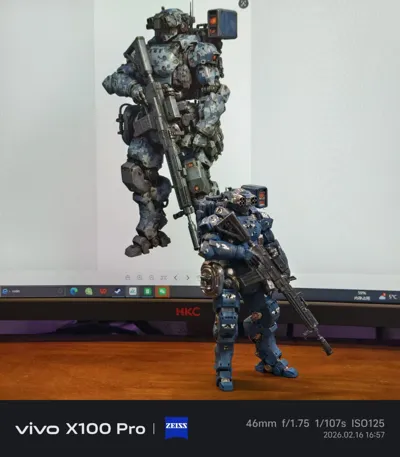
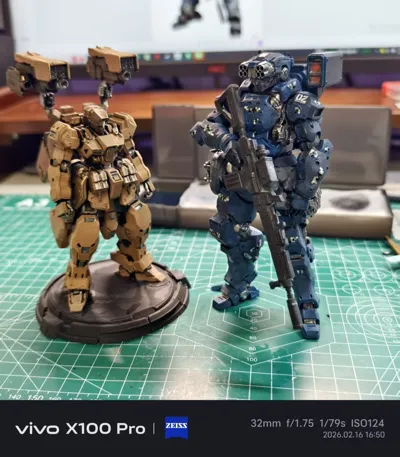
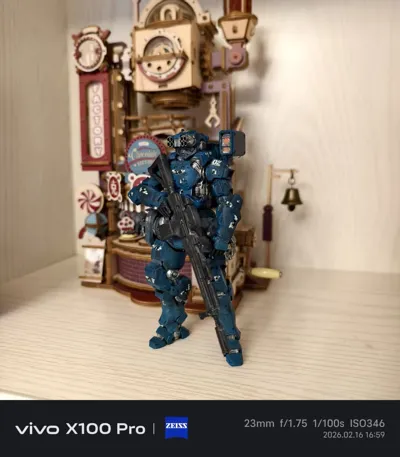
Code 2149 Future Warrior - Asian Alliance Assault Type
Print Profile(0)
Description
To begin, this is a fictional framework of my sci-fi worldview, not real, and an attempt. If you like it, please boost me, and I will continue to update it, hehe
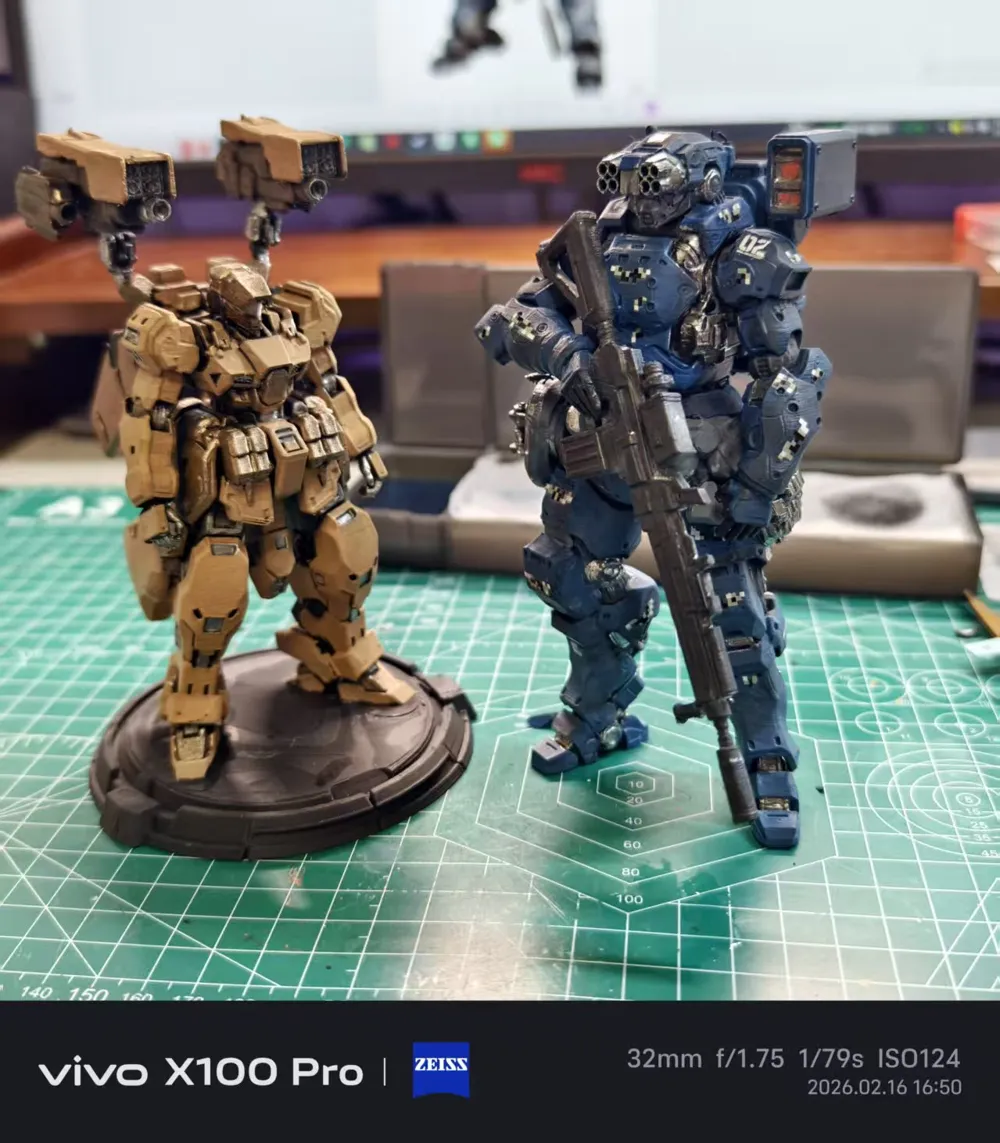
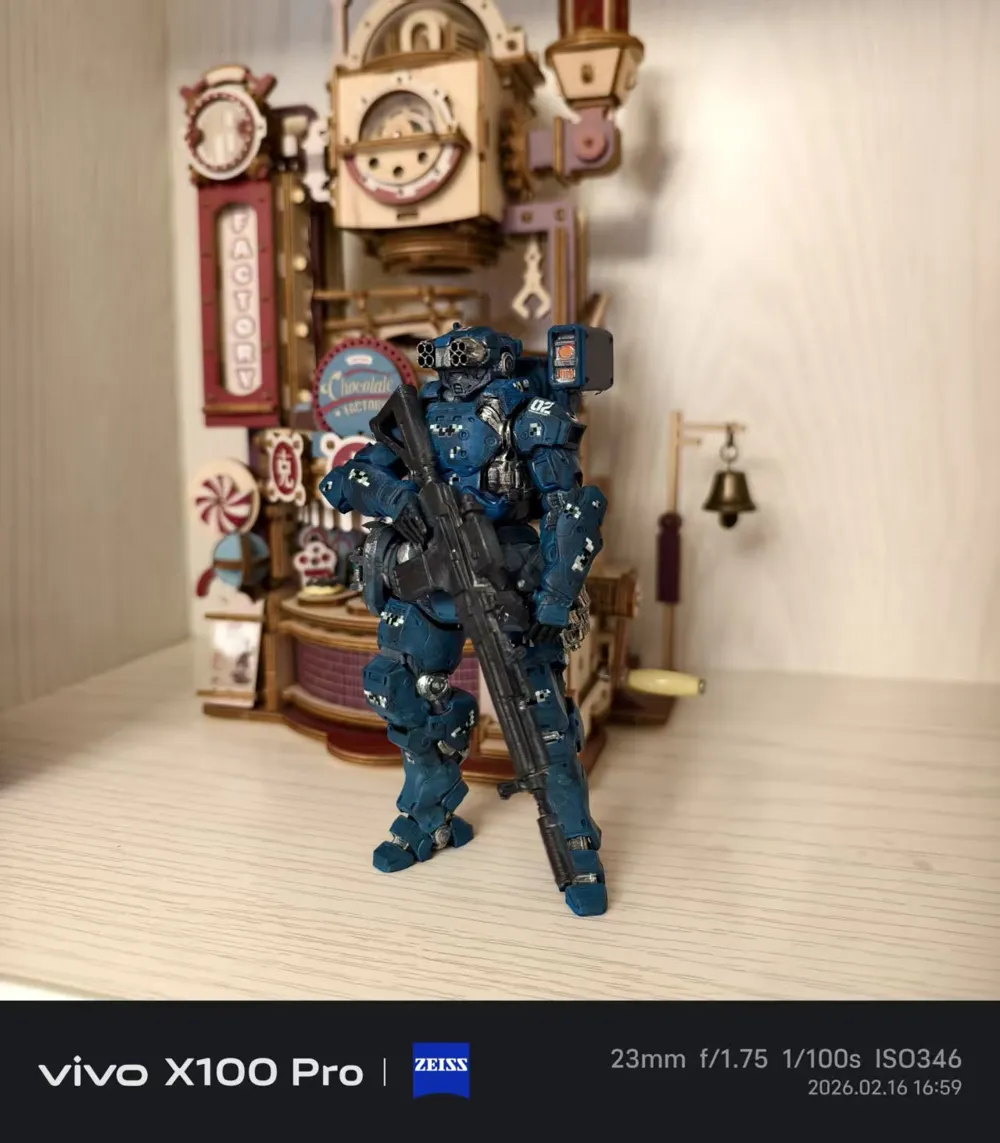
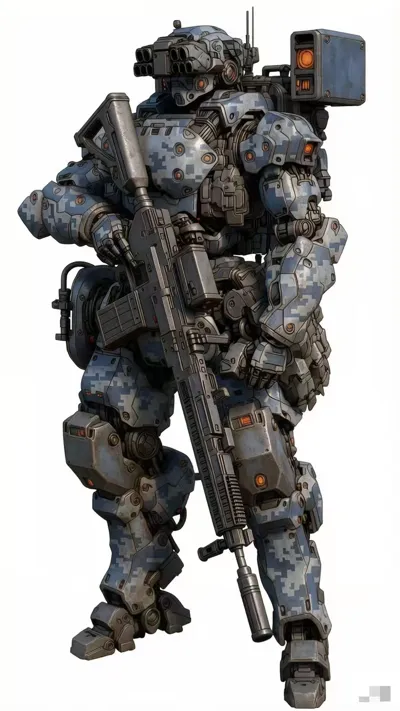
Asian Alliance "Azure Wolf" Assault Tactical Mech
I. Technical Analysis: The Pinnacle of Modular Survival and Networked Combat
Under the technological influence of controllable quantum society and the Digital Silk Road, the Asian Alliance's single-soldier mech achieves a trinity integration of "biological-mechanical-information," with each design pointing to the core requirement of "full-domain coordinated penetration":
Dynamic Fluid Armor
Material: Nanoscale magnetorheological polymer matrix, embedded with "quantum anchor particles" extracted from controllable nuclear fusion byproducts. These particles can be oriented by magnetic fields, allowing the armor surface to switch between "rigid defense → flexible buffering → energy absorption" in 0.3 seconds.
Defense Logic: Designed against specialized weapons of the Wraith civilization, such as plasma beams and gravitational wave fragmentation bombs, the armor can dynamically adjust local hardness (with a maximum impact resistance of 1200MPa); simultaneously, nanoparticles can capture the residual energy of kinetic projectiles, converting it into miniature generators to replenish power.
Neural-Fire Control Nexus
At its core is the Asian Alliance's third-generation non-invasive brain-computer interface (inherited from civilian medical-grade brain control technology, later militarily enhanced). Soldiers' alpha/beta brainwaves, after quantum encryption, directly drive the fire control computer to complete "target identification → ballistic calculation → multi-weapon linkage."
Tactical Value: Coupled with full-domain data chain sharing, soldiers can real-time access teammates' sensor views (such as infrared, quantum radar) to achieve "one aims, whole team calibrates" swarm strikes; shooting response delay is compressed to 15 milliseconds, comparable to biological instinct.
Adaptive Cloak Field
Principle: Based on the quantum phase modulation technology of a controllable quantum society, dynamic electromagnetic fog is generated around the mech. The field can anchor environmental electromagnetic features (such as battlefield dust, building structures) through quantum entanglement, achieving "optical → infrared → radar" full-spectrum stealth.
Tactical Limitations: Due to energy constraints (miniature nuclear fusion reactor power allocation priority is lower than thrusters/weapons), stealth mode only supports 15 minutes of continuous combat, requiring cooperation with "flicker assault" tactics—briefly activating stealth for infiltration, then withdrawing with suppressive fire.
Cyborg Survival Matrix
Power: A miniature controllable nuclear fusion reactor (output power 3.2MW) is mounted on the back, combined with superconducting energy storage coils, meeting the system's 72-hour high-intensity combat demand.
Medical: Joint gaps house "nanosuture clusters," automatically releasing coagulant and antibacterial nanobots upon injury, increasing battlefield survival rate by 47%; bioelectric interfaces in the spine can directly connect to teammates' emergency drone swarms, achieving "repair initiated before the wounded fall."
II. Development Origin: The Evolutionary Chain from Energy Hegemony to Baptism by Fire
The birth of the Asian Alliance tactical mech is a threefold inevitability of the East Asian energy chain → Digital Silk Road → controllable quantum society technological iteration, and even more so, a survival imperative under the "Wraith threat":
Technology Accumulation Period (2031 - 2049 | Eve of the Great Rupture)
The Dragon Nation-led East Asian energy chain integrated ASEAN and Central Asian resources, completing dual infrastructure of "land-based controllable nuclear fusion + quantum communication satellite networking." At this time, abnormal energy fluctuations from alien "deep space gaze" triggered alarms, and the military, under the guise of "counter-terrorism and riot control," developed the first-generation powered exoskeleton prototype—clumsy hydraulic joints, a 0.5-second delay in wire-controlled fire control, yet it verified the collaborative feasibility of "bio-neural + mechanical enhancement."
War-Driven Incubation Period (2050 - 2070 | Era of Full-Domain Defense)
After the first large-scale Wraith invasion, traditional infantry was annihilated under the combined assault of "gravitational tearing bombs + intelligent nanobots." The Asian Alliance urgently initiated the militarization transformation of the "Digital Silk Road":
Transforming the civilian quantum network (originally planned for trade settlement) into a battlefield data chain, upgrading soldier brain-computer interfaces from "industrial remote-controlled mechanical arms" to "neural-linked weapons";
In 2065, the first batch of "Prototype Azure Wolves" was deployed to the South China Sea defense line—although endurance collapsed due to uneven energy distribution (insufficient nuclear fusion reactor power), it shot down 3 Wraith shuttles within 1 hour, proving the potential of "network-centric warfare" for dimensional reduction strikes.
Systemic Maturity Period (2071 - 2149 | Tri-Polar Era Formation)
After the establishment of the Asian Alliance by the "New Chang'an Treaty," the computational explosion of controllable quantum society (brain-computer interface coverage exceeding 60% in the entire region) brought qualitative changes to mechs:
Armor Material Innovation: Mass production of "quantum anchor particles" generated by nuclear fusion solved the problem of energy response lag in dynamic armor;
Societal Structure Imperative: The Asian Alliance's social system, centered on "contribution points," demands that mechs possess "rapid post-war production conversion" capability—modular weapon interfaces can be replaced with engineering drills, disaster relief robotic arms, making the mech a "mobile production unit";
Civilizational Imprint: Unlike Europa's radical enhancements of "human-machine fusion" or Aurab's theological symbols of "religion-tech symbiosis," the Azure Wolf's design consistently anchors to its "network node" attribute—the blue-grey camouflage on the mech's surface is a visual representation of the Digital Silk Road's data flow.
III. Civilizational Imprint: More Than Just a Weapon, It's a Societal Organ
When Asian Alliance soldiers pilot the Azure Wolf, they transcend the biological realm of "human-machine unity"—every energy consumption, every battlefield kill by the mech, is converted into brain-computer interface contribution points, becoming the core credential for social status and resource allocation. This design philosophy of "combat is production, survival is construction" makes the Azure Wolf not only a sharp blade against aggression but also a concrete projection of the Asian Alliance's "technological utopia" in war. As Wraith gravity bombs tear through the atmosphere, swarms of Azure Wolves, shimmering with quantum camouflage, carry the network genes of the entire Asian civilization, launching a counterattack into deep space.
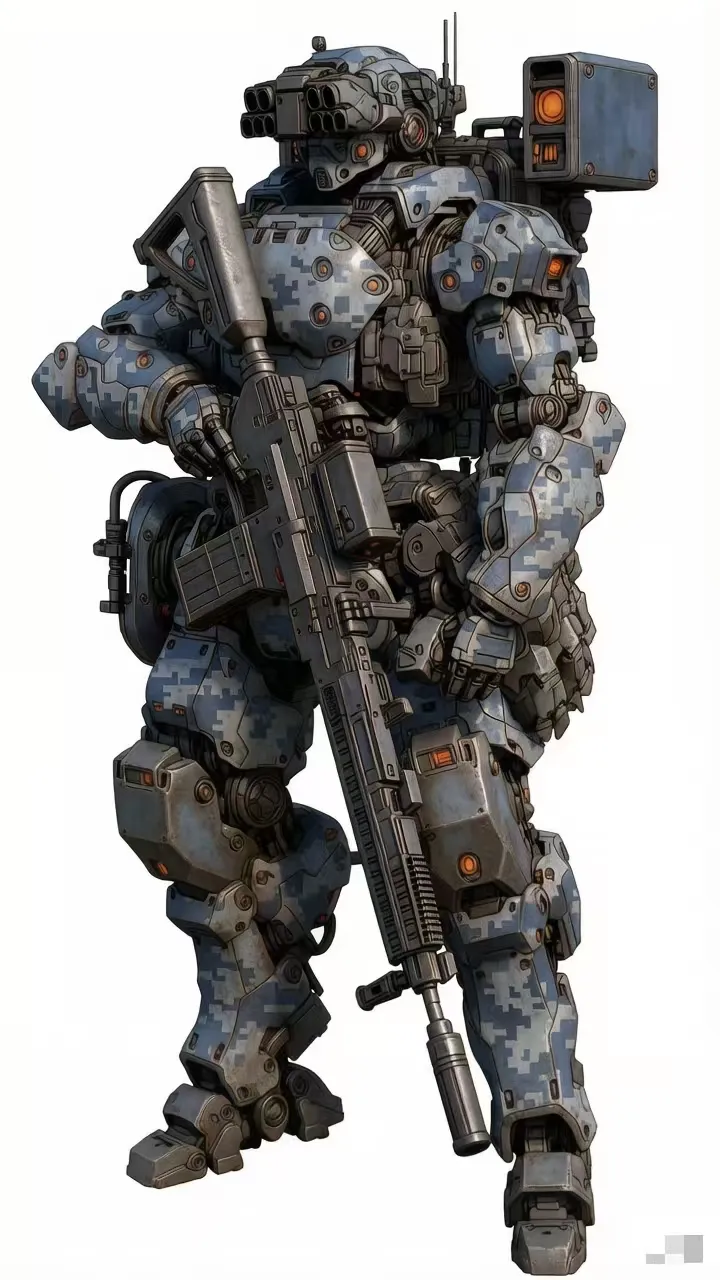
I. Core Positioning: Asian Alliance Tactical Reconnaissance Node
This mech is the Asian Alliance's independently developed fourth-generation reconnaissance combat platform, project codename "Azure Wolf". As a mobile terminal of the "Digital Corridor" combat network, it focuses on the trinity mission of battlefield perception, information relay, and precision strike, embodying the Asian Alliance's tactical philosophy of "controllable enhancement, efficient synergy."
II. Observation and Perception System
Integrated Reconnaissance Unit (IRS-7 type) in Head
1. Multispectral Integrated Observation System
- Main Sensor: IRS-7A Multispectral Compound Eye Array
- Functional Bands: Visible Light (0.4-0.7μm), Infrared (3-5μm/8-12μm), Ultraviolet (0.2-0.4μm)
- Detection Accuracy: Visible light resolution 0.05 milliradians, infrared temperature difference sensitivity 0.02K
- Additional Module: Laser Rangefinder (Max range 20km, accuracy ±0.5m)
2. All-Weather Reconnaissance Suite
- Low-Light Enhancement System: Effective recognition distance of 1.5km in starlight environment
- Thermal Imaging Array: 640×512 pixels, refresh rate 60Hz
- Acoustic Positioning Array: Mechanical vibration recognition accuracy of 85% within 5km
3. Data Link and Communication
- Quantum Encrypted Communication Antenna (QE-4 type)
- Transmission Rate: 100Gbps (theoretical value)
- Anti-Interference Protocol: Uses "Digital Corridor" quantum network dedicated encrypted channel
III. Combat System Configuration
1. Power System
- Main Energy: DFR-3 type Miniature Fusion Reactor
- Fuel Type: Deuterium-Tritium mix
- Output Power: 3.2MW (continuous)
- Operating Life: 15,000 hours (standard conditions)
- Auxiliary Energy: Joint Kinetic Energy Recovery System (recovery efficiency 15%)
2. Weapon Platform
- Main Weapon: TAR-12 Tactical Assault Rifle
- Caliber: 6.8×45mm
- Ammunition Type:
- AP-I type (Armor-Piercing Incendiary)
- QD type (Quantum Jamming Round)
- Fire Control System: Integrated Quantum Ballistic Computer, reaction time ≤0.1 seconds
- Defense System: PLD-2 Point Defense Laser (both sides of waist)
3. Protection System
- Active Protection:
- Adaptive Optical Camouflage System (AOCS)
- Quantum Noise Jammer (QNJ-1 type)
- Passive Protection:
- Composite Armor Structure (Outer layer: Silicon Carbide Ceramic; Middle layer: Graphene-Titanium Alloy Mesh; Inner layer: Bulletproof Fiber)
- Self-Repairing Coating (nanorepair colloid filling)
IV. Control and Information System
1. Human-Machine Interface
- Control System: NMI-4 type Non-Invasive Neural Interface
- Signal Delay: ≤8ms
- Error Rate: <0.01%
- Auxiliary AI: "Sentinel" Tactical Decision Support System (provides advisory authority only)
2. Data Fusion Processing
- Central Processor: QC-9 Quantum Coprocessor
- Storage Capacity: 128PB (expandable)
- Data Processing Speed: 1.2×10¹⁵ operations/second
V. Technical Parameters
Item Specification
Overall Height 2.8 meters
Combat Weight 1.2 tons
Maximum Movement Speed 75km/h (flat ground)
Continuous Combat Time 120 hours (standard mode)
Effective Sensor Radius 20km (quantum radar mode)
Communication Range Global (quantum satellite relay)
Environmental Adaptability -50℃ to +70℃, all-terrain passability
VI. Development History
1. Prototype Phase (2095-2105)
- Project Initiation: Reconnaissance modification based on the "Xuanju" exoskeleton platform
- Technology Verification: Preliminary testing of IRS-1 type reconnaissance system
2. Design Finalization Phase (2120-2140)
- System Integration: Integration of DFR-2 reactor and QC-7 processor
- Combat Validation: Participated in three border conflicts, system reliability verified
3. Mass Production Phase (2149 to present)
- Production Line Establishment: Supported by "Digital Corridor" industrial network
- Deployment Scale: Currently equipped by 12 reconnaissance battalions, totaling 1200 units
VII. Tactical Applications
1. Reconnaissance Mode
- Silent Reconnaissance: All sensors active, communications silent
- Mobile Reconnaissance: Area scanning at 30km/h
- Covert Reconnaissance: AOCS system operating at full power, continuous for 6 hours
2. Guidance Mode
- Target Designation: Provides real-time coordinates for rear firepower units
- Battlefield Assessment: Generates 3D battlefield situational map (update frequency 1 time/second)
3. Independent Combat
- Precision Strike: 95% hit rate for targets within 2km
- Area Denial: Establishes defensive barrier in conjunction with PLD system
VIII. Maintenance and Support
1. Routine Maintenance
- Three-level maintenance system: operator level (daily), unit level (monthly), base level (yearly)
- Mean Time Between Failures: 5000 hours
2. Battlefield Repair
- Modular Replacement: Major components can be replaced within 30 minutes
- Frontline Support: "Digital Corridor" provides 3D printed spare parts support
IX. Upgrade Plan
1. Recent Improvements (1-2 years)
- Sensor Upgrade: IRS-8 type array (detection range increased by 20%)
- Energy Optimization: DFR-3A type reactor (efficiency increased by 15%)
2. Long-Term Planning (3-5 years)
- Integrated Brain-Computer Interface: NMI-5 type (signal delay reduced to 5ms)
- Autonomous Coordination Capability: Multi-mech tactical network (supports up to 8 mechs in coordination)
Note: All technical parameters in this archive are based on the Asian Alliance Military Standard MAS-2148 Revision, and actual performance may fluctuate due to combat environment and maintenance status. Technical naming follows the "Asian Alliance Equipment Naming Specification" (AAN-2079) to ensure compatibility with existing combat systems.
License

You shall not share, sub-license, sell, rent, host, transfer, or distribute in any way the digital or 3D printed versions of this object, nor any other derivative work of this object in its digital or physical format (including - but not limited to - remixes of this object, and hosting on other digital platforms). The objects may not be used without permission in any way whatsoever in which you charge money, or collect fees.


Comment & Rating (0)