
Band Theory Model (Solid State Physics, Semiconductor Physics)
Print Profile(1)
Description
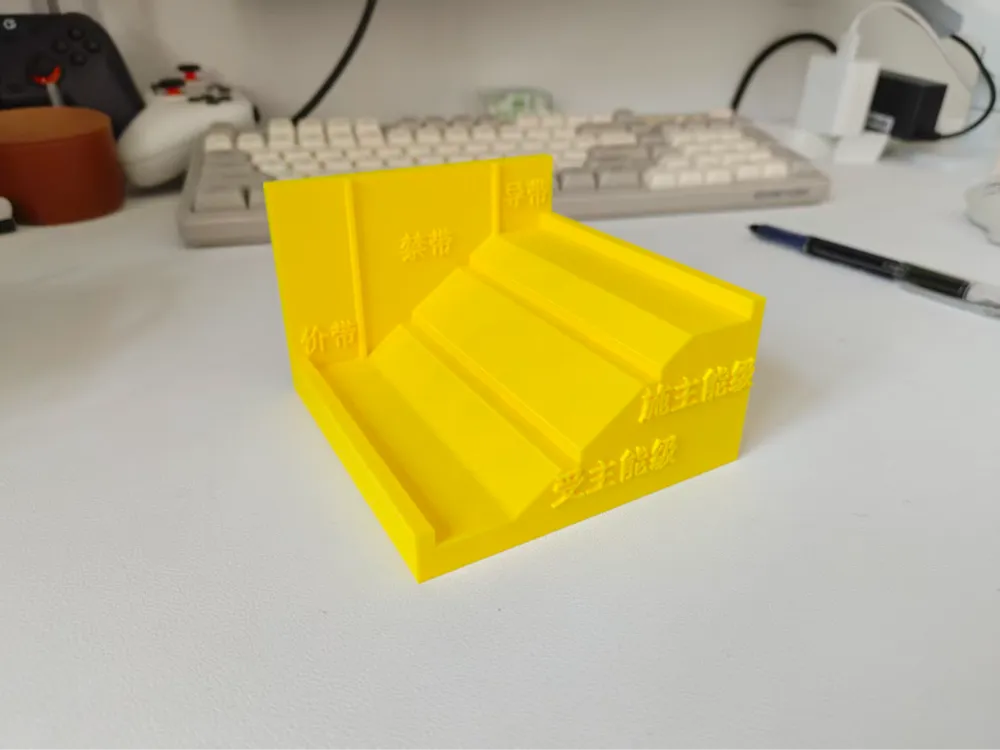
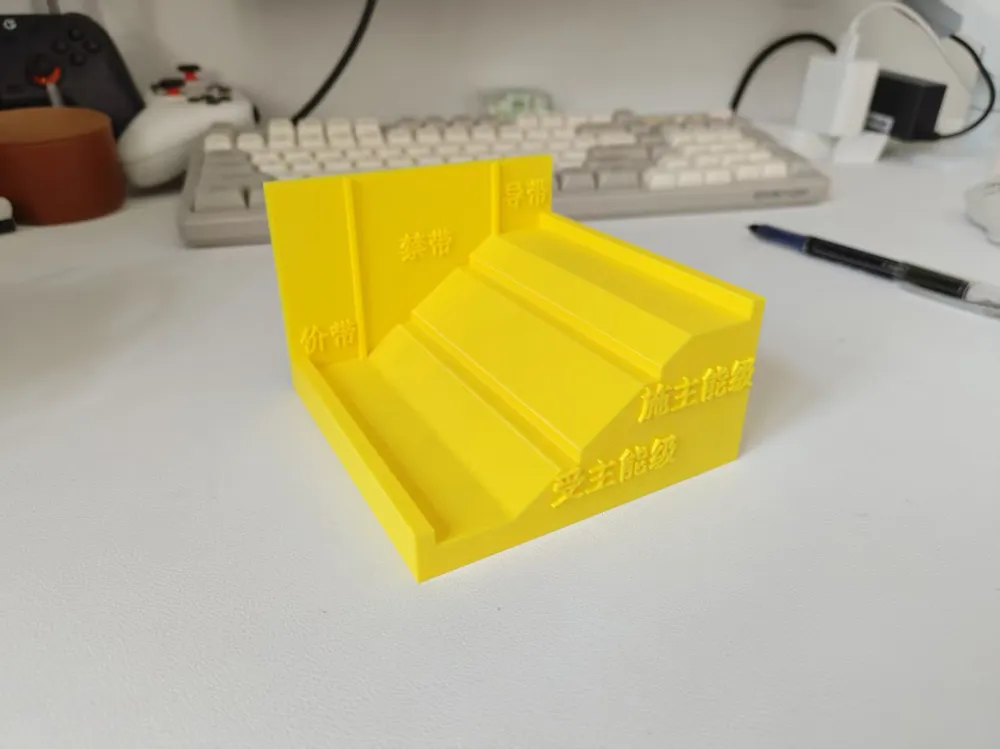
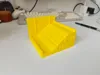
This is a didactic model for learning band theory.
It originated from an idea I had in my mind during class—later, when explaining to classmates, I realized that most people's understanding of energy bands was limited to "a few abstract lines." So, I created and shared this model, hoping to help more people intuitively understand band structure.
⚠️ Note
This model only displays the shape of energy bands in energy space and is a simplified version. The actual band structure of different materials will vary.
💡 Instructions
Imagine a small ball (electron) moving on the model:
- Gravitational potential energy → Analogous to the energy barrier required for electron transition
- Height difference → Analogous to different energy levels
- Bottom region → Valence band (the electron's "home")
- Top region → Conduction band (the electron's "new home" after transition)
- Band gap (sloping region) → Region where electrons cannot stay, but it contains donor energy levels (near the bottom of the conduction band, providing a "springboard" for electrons) and acceptor energy levels (near the top of the valence band, providing a "springboard" for holes)
The process of an electron transitioning from the valence band to the conduction band is analogous to a small ball climbing uphill, overcoming gravitational potential energy (energy barrier).
License

You shall not share, sub-license, sell, rent, host, transfer, or distribute in any way the digital or 3D printed versions of this object, nor any other derivative work of this object in its digital or physical format (including, but not limited to, publishing derivative works outside the Makerworld platform or hosting on other digital platforms). The objects may not be used without permission in any way whatsoever in which you charge money or collect fees. Subject to the above restrictions, derivative works may be published only within the Makerworld platform, and all such derivative works must be licensed under the same SDFL‑C license, without modification or additional terms. You may download the digital versions of this object, 3D print it, and display images, videos, or usage demonstrations of 3D printed versions of the object on personal social media platforms or Makerworld official channels, provided that no digital versions of the object are shared or distributed.


Comment & Rating (0)