
Sanding Cylinders




Print Profile(1)

Description
Boost Me (for free)
Do you like my designs? Then hit boost, please. This helps me a lot, especially as my recent designs get more complicated and thus expensive to prototype. Boosts help me to afford new prototyping filament and printer replacement parts. Thank you!
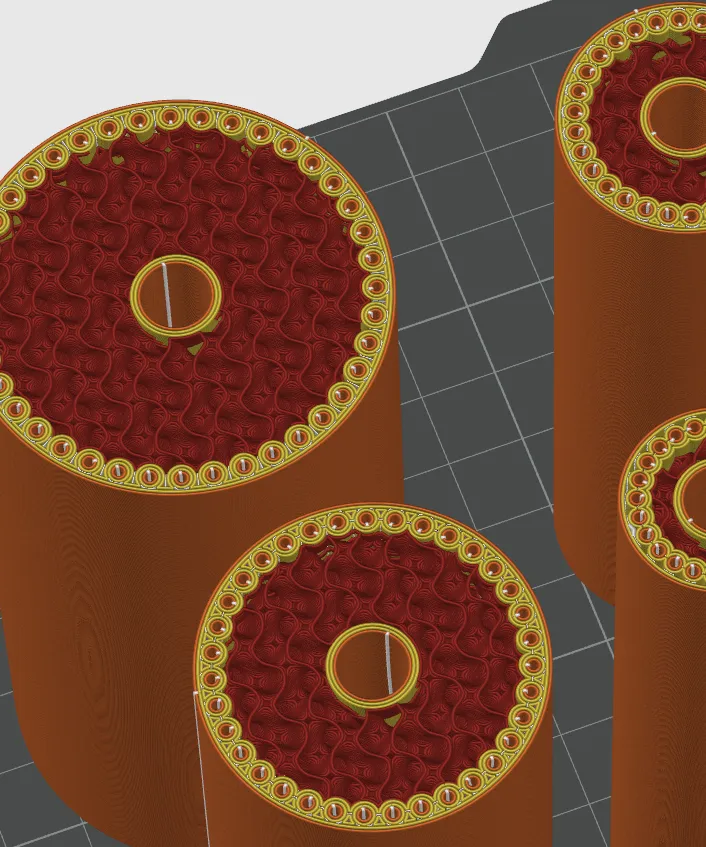
Update: stronger models in v5! These models contain structures that force the slicer to build more walls at the outer wall side! Also, consider if you want to print the cylinders from PLA, PETG or TPU. PLA is easy to print but prone to thermal warping. PETG can withstand a little more stress and heat, TPU could be useful for sanding down sharp edges to rounded forms due to its squishiness. Feel free to add printing profiles for different materials.
Simple sanding cylinders. I made the first ones from wood but there are limited in the diameters I can drill so here are cylinders with 15, 20, 23, 30, 40, 50 mm diameters. All of them are 115mm in height which matches rolls of Bosch sanding paper (https://www.amazon.de/gp/product/B00141637I). The spindle hole is 8mm in diameter, so it matches M8 threaded rods (which are 7.8mm in diameter) within some tolerance. I assembled them with 3 hex nuts and 17cm long threaded M8 rods and my drillpress bearing (link), strong doublesided adhesive tape and sanding paper
Boost Me (for free)
If you like my work, please consider a boost. This helps me to afford new equipment and prototyping filament :)
For all of my models that include supports, I highly recommend a detailing / support removal tool like the one from anish or C59. Those make use of a replacement filament cutter and have proven themselves a very valuable tool for clean and easy support removal, especially for threads.
Also, please keep in mind, that the quality of threads is highly dependent on the quality and dryness of your filament, the calibration of your printer and the print resolution. A thread printed with .2mm layer height will be way harder to thread nicely and will require more force, than a thread printed at .08mm or .12mm layer height. Also, the Arachne wall generator does contribute a lot to precise threads. If you need more part strength, increase the number of walls, make use of the alternate extra wall feature and DO NOT use PLA.
If you like my work and want to support me, please consider boosting or buying me a coffee :)

Boost Me (for free)
I you like my work, please hit boost or consider buying me a coffee - this helps this project to reach more makers and new designs coming as I am able to afford new prototyping filament. Thank you!
License



Comment & Rating (11)