
Mini Globe world map with base and Moon


Print Profile(1)

Bill of Materials


Description
Mini Globe world map with base and Moon in brief
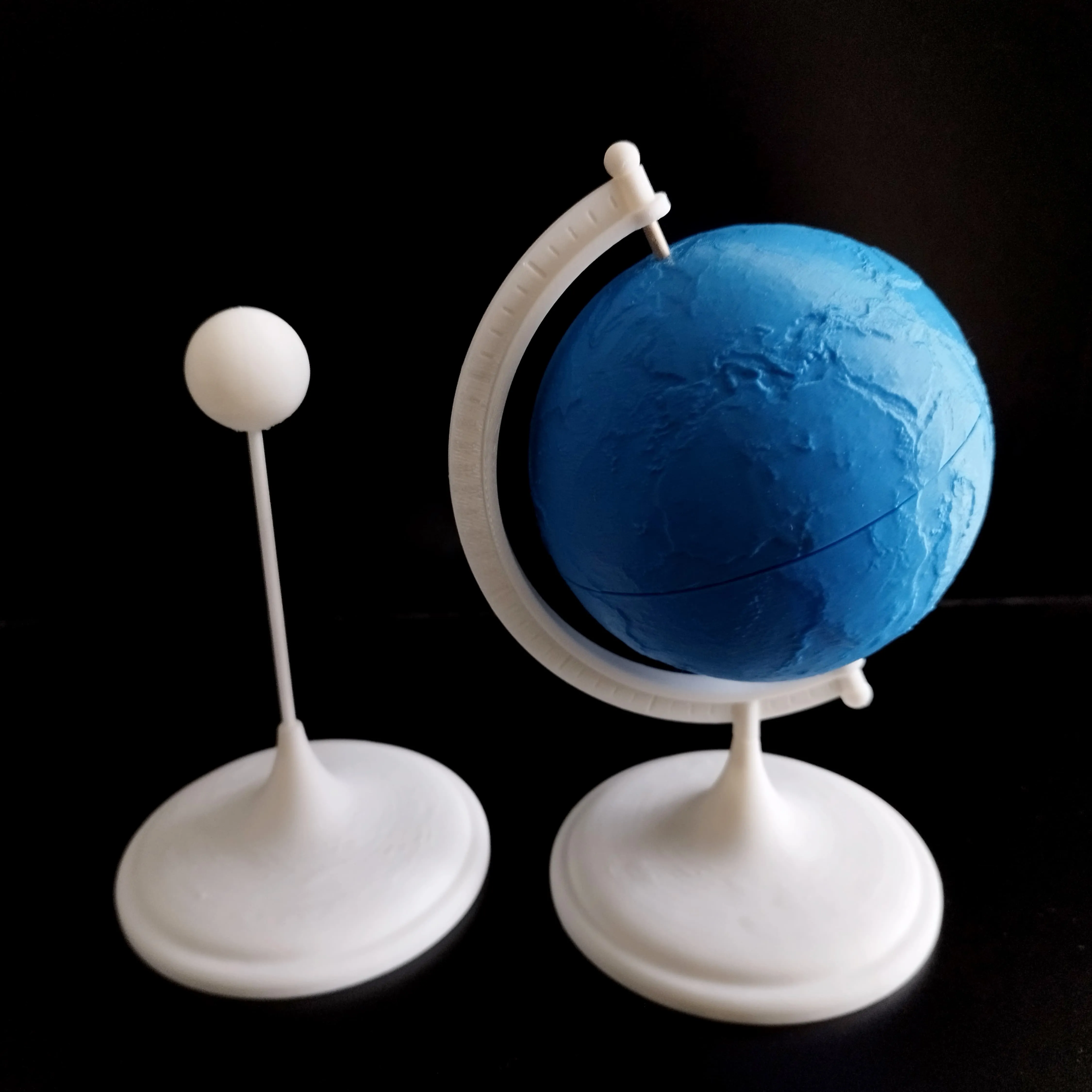
This mini globe with meridians and parallels in relief, along with the Moon at the same scale as Earth, can be used as a decorative ornament or an educational tool to explore a variety of concepts. By using a flashlight or small lamp, students or kids can learn about the phases of the moon, the cycle of day and night, and the changing seasons. It also helps illustrate the Arctic seasons, solar insolation at different latitudes, and the mechanics of solar and lunar eclipses. This hands-on approach offers a visual and interactive way to understand Earth's movements and their effects.
Main features
- Model scale of 1 : 127,420,000 (Moon at the same scale as Earth)
- Globe with meridians and parallels in relief
- The globe can rotate
- Vintage-antique style
- Suitable for educational and decorative use in the home.
- Dimensions: globe ∅ 10 cm (3.937 inches)
- Total model height: 17.5 cm (6.899 inches)
- The model can be scaled up in the slicer to obtain larger versions
- The model consists of 4 separated parts (to be printed in 7 pieces)
- The globe is empty inside, lights can be added
- The globe can be easily removed and reinserted or changed
- Can be coloured, decorated and printed with different colours
- The stand is inclined at 23.45°, reflecting the Earth's rotational axis.
Description of the parts
The entire model consists of 4 pieces:
- Round base
- Globe Rod (3 mm ∅, 124 mm length)
- Globe stand with 23.45° inclination and angle indicators
- Globe with embossed parallels and meridians (22.5° separations)
Model data and dimensions
The model is at a scale of 1 : 127,420,000 to actual size.
The globe is a sphere with a diameter of 10 cm and the stand is inclined at 23.45°, reflecting the Earth's rotational axis. The base is a circle 10 cm in diameter and the model is a total of 17.5 cm high.
To reflect the Earth-Moon distance, the moon should be placed 301.64 cm (118.74 inches) away.
- Real data used:
- Earth diameter: 12,742 km (7,918 miles)
- Moon diameter: 3,474 km (2,158 miles)
Earth-Moon distance: 384,400 km (238,855 miles)
- Scaled data 1:127,420,000
- Earth diameter: 10 cm (3.94 inches)
- Moon diameter: 2.73 cm (1.07 inches)
- Earth-Moon distance: 301.64 cm (118.74 inches)
NOTE: The model can be enlarged by upscaling all pieces of the same factor in the slicer before printing to suit your needs, however, the tolerances of the parts could be excessive if enlarged and no longer optimal.
Description of the model and suggested use
This elegant 3D printed globe is a perfect complement for both interior design and educational purposes. Its compact size makes it ideal for display on desks, bookcases or coffee tables, adding a touch of style to any room. The accurate details of meridians and parallels give the globe a refined and realistic appearance, enhancing the viewing experience.
In addition, the globe can be coloured as desired, allowing for creative customisation that makes it unique. Whether you use it as a decoration or an educational tool, this 3D globe will be a beautiful addition to your home or office.
Educational use
By using a flashlight or small lamp, this model allows students to explore the phases of the moon, the alternation of day and night, and the changing seasons. It also illustrates the Arctic seasons, solar insolation at different latitudes, and solar and lunar eclipses. Additionally, it serves as a tool for understanding the Earth's coordinate system, including the equator, meridians, parallels, and latitude and longitude.
The model can also be used to retrace the Apollo space missions around and to the moon and retrace the orbits and the route taken in order to accomplish the missions.
This hands-on approach provides a visual and interactive way to grasp Earth's movements and their effects.
Example of moon phase demonstration with LED flashlight:

In the following image an example of studying the phenomenon of partial and annular solar eclipses with the moon model and a spherical lamp to simulate the Sun:

Inserting and extracting the globe
To insert the globe in the stand simply widen the holder gently so that the stick fits into the holder.
Join the pieces and mounting
To join the two-part pieces, use glue suitable for plastic materials, align the pieces correctly and allow to dry.
Insert the stick into the globe, insert the globe holder into the base and insert the globe into the holder. Check that the globe rotates freely.
A 3 mm or similar rod of 124 mm in length is required as a rod for the globe.
Use a 3 mm diameter and 124 mm long stick (e.g. a wooden skewer or similar) to pass through the globe. If you do not have one, print and use the rod included in the STL files.
Be sure to mount the halves of the 3d-printed parts correctly and in alignment, otherwise rotation of the globe may be difficult.


Globe with relief topography
If you want to have a globe with 3D topography I suggest you download this:
3D Globe topography remix model already modified by me here:
https://www.printables.com/model/1046095-globe-spheres-with-relief-topography-compatible-fo
In the following image the model with compatible globe with relief topography fully compatible.
Combinable models
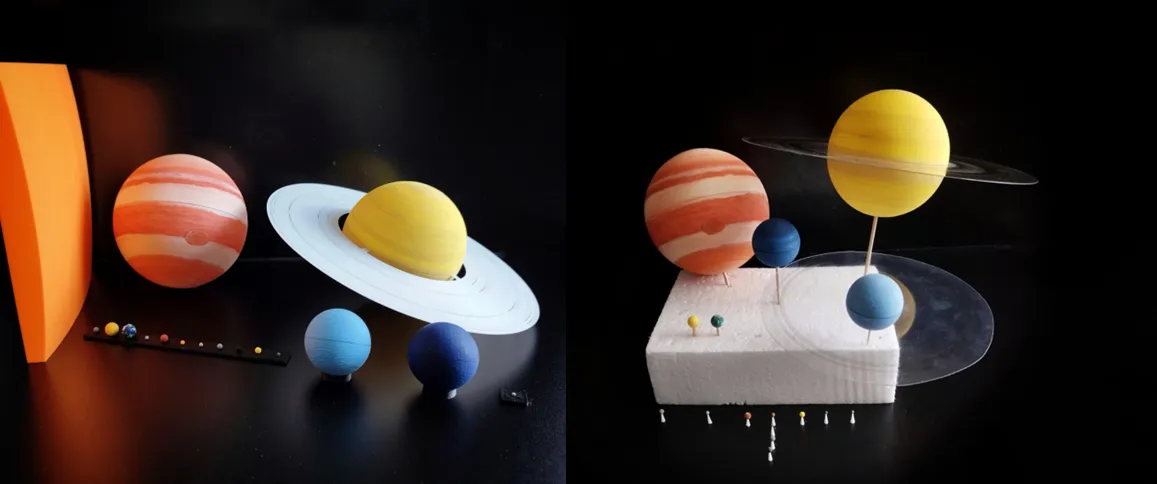
This set is great with my Complete Solar System Model 1:1,188,500,000 scale to better understand the positions of Earth and the Moon relative to the other planets in the Solar System and the Sun, and to study astronomical phenomena in our solar system.
For more information, downloadable resources including all model data in PDF format and an editable Excel spreadsheet, 3D files of all planets, rings, a piece of Sun and major moons are available and please refer to the main model page and description of the Complete Solar System Model 1:1,188,500,000 scale at the following link: https://makerworld.com/en/models/446109-complete-solar-system-model-1-1-188-500-000-scale
3D printing settings
Printing settings and tips
Globe:
- Layer: 0,1 - 0,08 mm (keep minimum)
- Infill: 0%
- Brims: NO
- Split in half into two hemispheres (north and south hemisphere)
Round base:
- Layer: 0,1 - 0,08 mm (keep minimum)
- Infill: 15%
- Brims: NO
- Infill pattern: gyroid
Globe stand:
- Layer: 0,1 - 0,08 mm (keep minimum)
- Infill: 75% (better resistance)
- Brims: NO
- Split in half into two pieces
Globe Rod:
- Layer: 0,1 - 0,08 mm (keep minimum)
- Infill: 100% (better resistance)
- Brims: NO
- Split in half into two pieces
See section “Slice and place on the printing plate” for details on how to slice and place pieces on the printing plate.
Slice and place on the printing plate
The following picture shows how to slice the parts without using supports and how to place them on the printing plate. Place the parts on the performed slice.

Test and results: result showed in the images are printed with white PLA basic filament with printer Bambulab P1S, 0.4 nozzle, Cool Plate / PLA Plate
If you liked this model or found it useful, please consider to leave a Comment, a Like, a Boost and rate the print profile ⭐!
If you have any questions, suggestions or requests regarding my designs, please leave a comment!
Your feedback is very important to me! Thank you so much ❤️!
See my other creations here on https://makerworld.com/@Elektrooon/upload or click the image below!
Boost Me (for free)
If you liked my model or enjoy using it, please consider making a Boost 🚀❗ Your support helps me keep creating and improving models like this, with new upgrades and enhancements that you can benefit from too! Thank you very much! ❤️ Elektrooon 🦝

License

You shall not share, sub-license, sell, rent, host, transfer, or distribute in any way the digital or 3D printed versions of this object, nor any other derivative work of this object in its digital or physical format (including - but not limited to - remixes of this object, and hosting on other digital platforms). The objects may not be used without permission in any way whatsoever in which you charge money, or collect fees.


Comment & Rating (4)