
NASA's Message to Extraterrestrial Life X Voyager 1




Print Profile(1)

Description
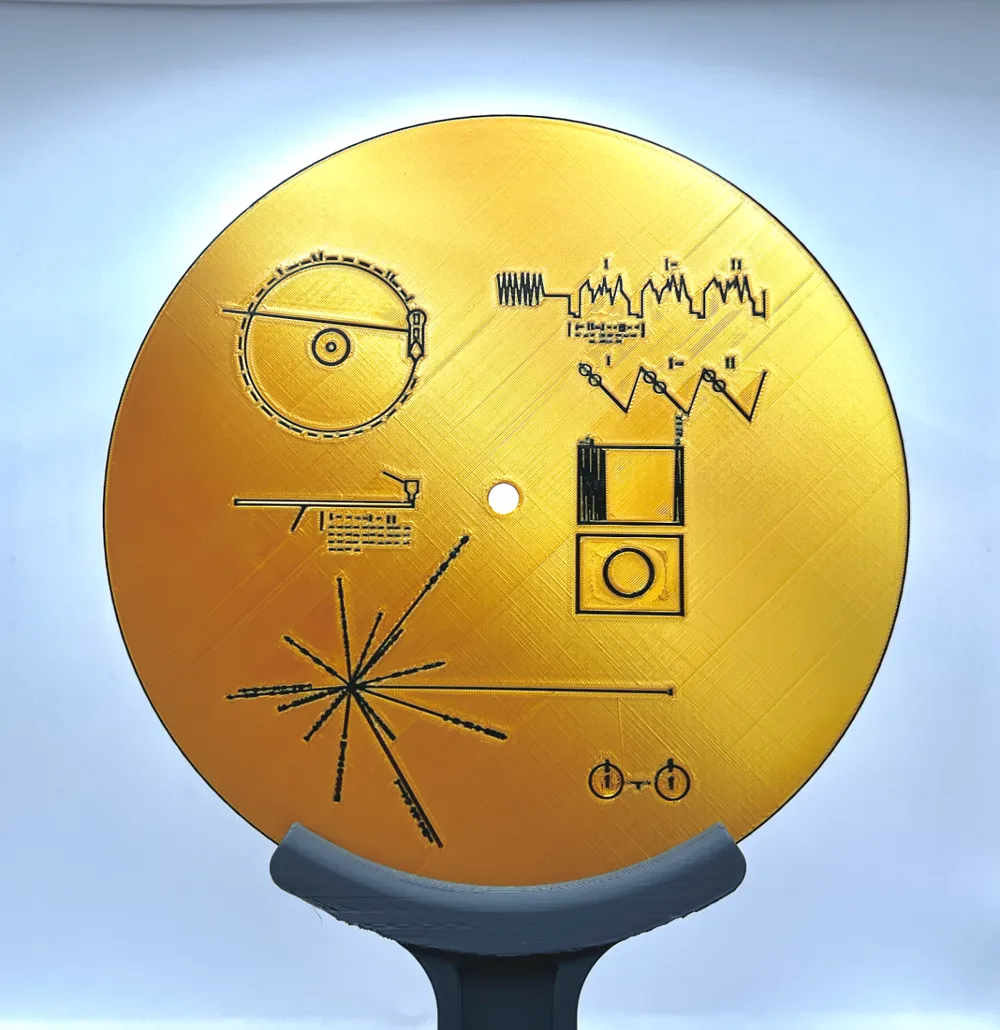
The most distant from planet Earth, human made object it´s finally here. The VOYAGER 1 Mission from NASA together with the Golden Record (Sounds of Earth Vinyl) also known as Earth´s message to Aliens.
Voyager 1 is more than just a spacecraft; it’s a symbol of human ingenuity, curiosity, and our relentless desire to explore the cosmos. Launched on September 5, 1977, Voyager 1 was part of NASA's Voyager program, designed to take advantage of a rare planetary alignment. This tiny yet robust spacecraft has traveled farther from Earth than any other human-made object, becoming a beacon of our species in the vastness of space.
The Purpose: Exploring the Outer Solar System
Voyager 1's primary mission was to explore the giant planets of our solar system—Jupiter and Saturn—and their moons. Its achievements include:
- Jupiter (1979): Captured the first detailed images of the planet's atmosphere, its Great Red Spot, and discovered active volcanoes on its moon Io, the first volcanic activity found beyond Earth.
- Saturn (1980): Revealed the intricate structure of Saturn's rings and provided detailed observations of its largest moon, Titan, which has an atmosphere rich in organic compounds.From Mission to Legacy: Voyager 1’s Ongoing Journey
After completing its primary mission, Voyager 1 embarked on its Interstellar Mission, heading into the unknown.
- Heliopause Crossing (2012): Voyager 1 became the first spacecraft to enter interstellar space, passing beyond the heliopause—the boundary where the Sun’s influence ends.
- Current Position (2024): Over 24 billion kilometers (15 billion miles) from Earth, Voyager 1 continues to send data back, offering insights into the interstellar medium.
The Golden Record: A Message for the Cosmos
One of Voyager 1’s most fascinating quirks is the Golden Record, a 12-inch gold-plated disc containing sounds, images, and messages from Earth.
- Purpose: To act as a time capsule for any intelligent extraterrestrial life that might encounter Voyager 1.
- Contents: Greetings in 55 languages, sounds of nature, music from around the world (including Bach, Beethoven, and Chuck Berry’s “Johnny B. Goode”), and images depicting life on Earth.
- Fun Fact: Carl Sagan, who led the team that created the Golden Record, described it as "a bottle cast into the cosmic ocean."
Where Will Voyager 1 Be in the Future?
Voyager 1's journey will outlast human civilization as we know it.
- In ~75,000 years, Voyager 1 will pass near Proxima Centauri, the closest star to our Sun, at a distance of 4.24 light-years from Earth.
- In ~200 million years, it will drift past the Orion Nebula.
- It will remain in orbit around the center of the Milky Way, potentially lasting billions of years as a relic of our civilization.
Building Voyager 1: NASA’s Achievement
The Voyager spacecraft were designed by NASA’s Jet Propulsion Laboratory (JPL) with state-of-the-art 1970s technology:
- Size: 3.7 meters (12 feet) in diameter with its high-gain antenna.
- Weight: 722 kilograms (1,592 pounds).
- Power: Three radioisotope thermoelectric generators (RTGs), which still provide power today, albeit at reduced levels.
- Durability: Designed to survive the harsh environment of space for decades, Voyager 1 has far exceeded its expected lifetime.
Interesting Quirks of Voyager 1
- Speed Demon: Voyager 1 travels at ~61,000 km/h (38,000 mph), making it one of the fastest spacecraft ever built.
- Silent Witness: It carries onboard instruments like magnetometers, plasma detectors, and cosmic ray sensors, which continue to provide data about interstellar space.
- Pale Blue Dot: In 1990, Voyager 1 turned its camera back toward Earth and captured the famous "Pale Blue Dot" image, a humbling view of our planet as a tiny speck in the vastness of space.
Conclusion: Humanity’s Eternal Emissary
Voyager 1 is not just a spacecraft; it is a testament to human ingenuity, curiosity, and our deep-seated need to explore and understand the cosmos. As it drifts farther into the unknown, it carries with it the hopes, dreams, and legacy of humanity—a small yet profound mark on the infinite canvas of the universe.
Add this extraordinary piece of history to your collection, and hold in your hands a model of the spacecraft that has traveled farther than any other.
Voyager 1, humanity's eternal emissary.
So this is my first AMS Print, there´s no assembly manual as all parts are plug and play, all of them are very easy to install (just take a look to main photos to follow assembly), for some parts you´ll need to use some hard glue to stick them together.
TAKE CARE AS SOME PLATES CAN BE DONE WITH O.4 Nozzle, while other´s needs to be done with 0.2 Nozzle (All this info displayed over buildplates)
Also take care when removing supports as some parts are very fragile. :)
Documentation (1)
License

You shall not share, sub-license, sell, rent, host, transfer, or distribute in any way the digital or 3D printed versions of this object, nor any other derivative work of this object in its digital or physical format (including - but not limited to - remixes of this object, and hosting on other digital platforms). The objects may not be used without permission in any way whatsoever in which you charge money, or collect fees.


Comment & Rating (72)