
Cafe Nora – a Toy Espresso machine & grinder
Print Profile(1)

Description
Espresso machine
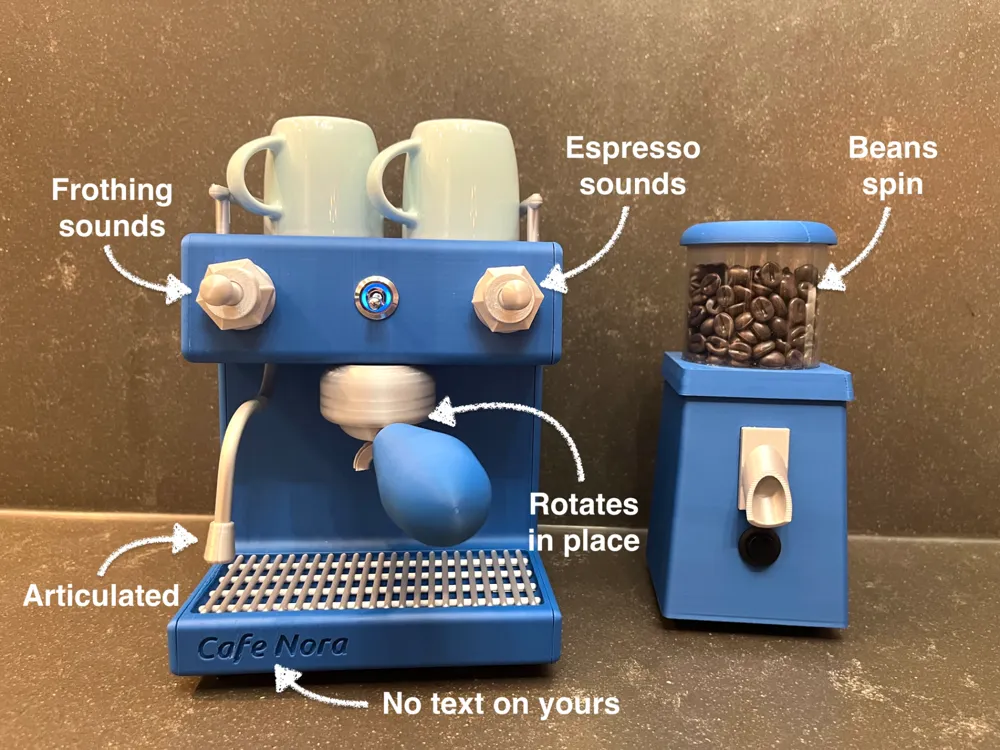
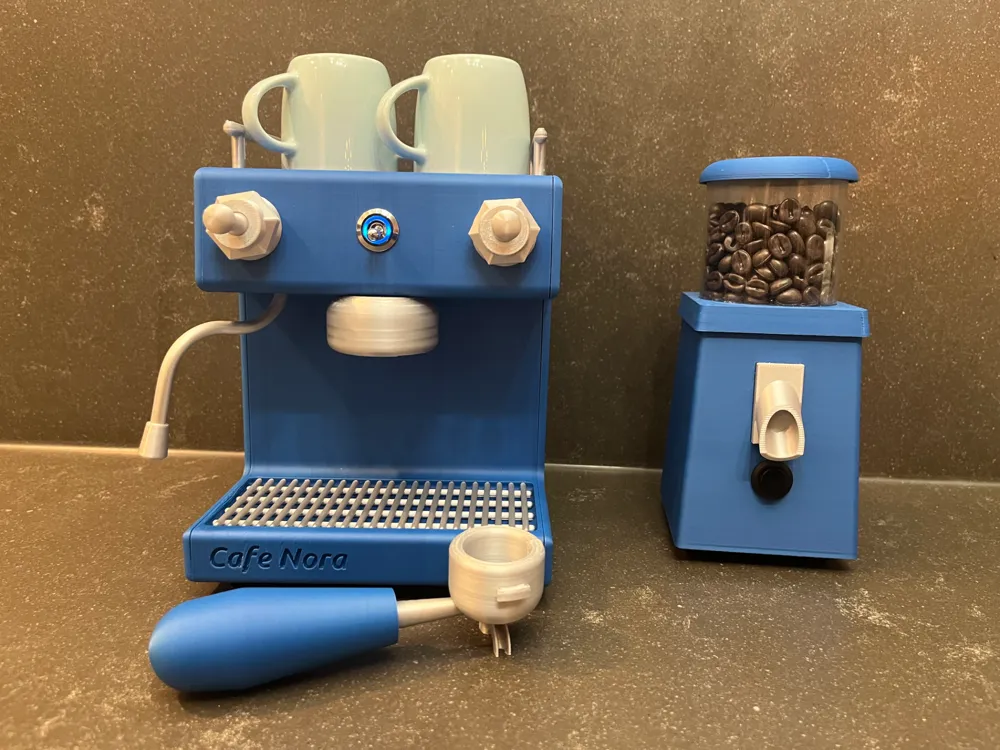
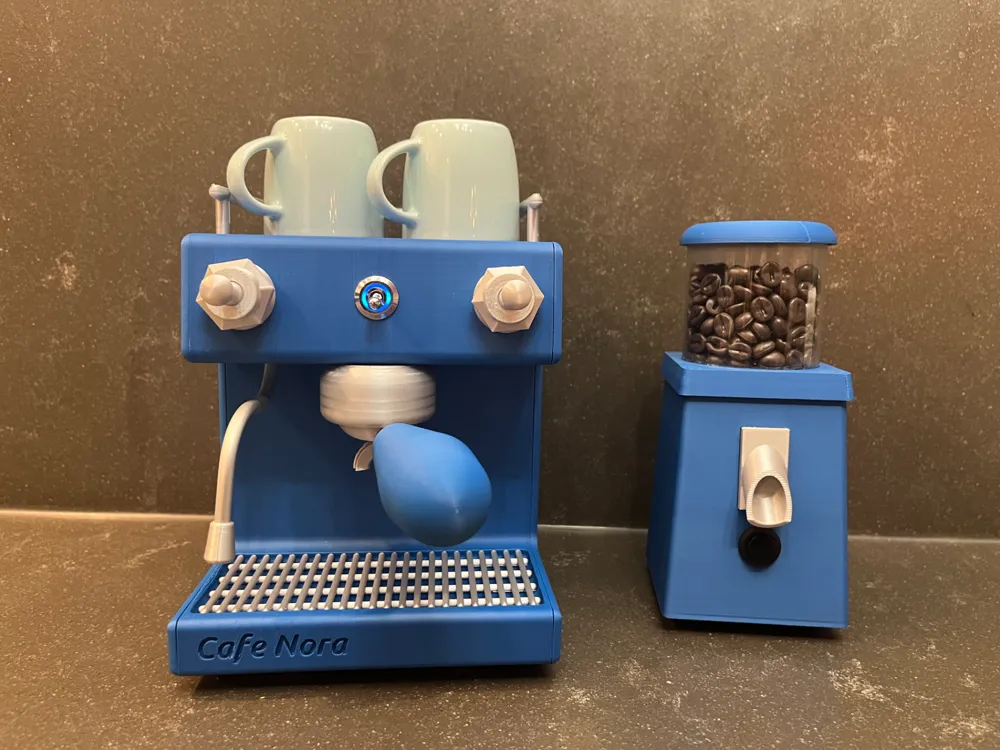
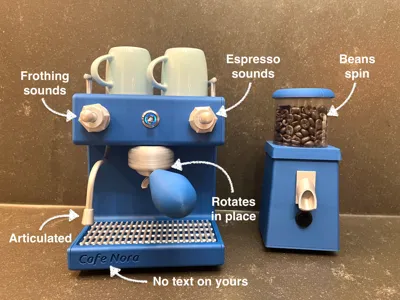
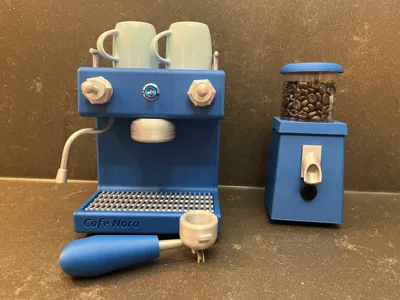
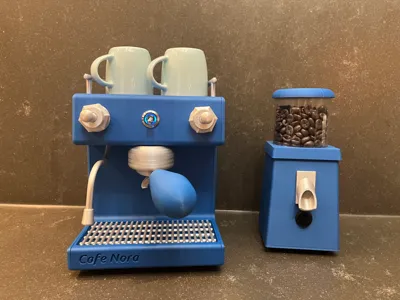
This large and rather elaborate model will take a while to print, but children (and grown ups) will love it. Especially if those children have parents with fancy espresso machines. My daughter always wants to help make espresso and cappuccino on my Bezerra espresso machine but almost every part of it can burn you, so she can't really help much. She does like the process and she can now enact it on her very own endgame espresso machine.
Fine print
This model contains small parts, don't let small children play with them unattended.
About this model
I once attempted to add a sound board to my daughter's toy coffee machine. In the process I ended up accidentally breaking it. I promised her a new espresso machine that does make sound. I then proceeded to build it out of MDF and it kept snowballing, more features, more weight, never finishing. And it was unwieldy for a child.
I got a printer a couple of years ago, so I designed this machine, but I could not print it successfully in any reasonable amount of time.
Fast forward a couple of years, I have a super fast 3d printer now so I picked it back up and finished the model. I printed a couple of iterations, went through a couple of KGs of filament to get to this point.
Evolving model
While the model and electronics for this machine are done, I'm planning to add a micro controller, and an optional sensor that detects that the steam wand is in use to change the sound from steam to frothing. Those features aren't done yet. The steam wand frothing feature will require more hardware, I'll make sure it is optional. The plan is to put a double glass fiber cable (proximity sensor cable) in the pipe that carries IR light in one fiber and uses the other fiber as a return signal wire to detect a reflection of a nearby object (a frothing jug).
BOM
Besides about a KG of filament you will need quite some components to build this design. It depends a bit how far you want to take it.
Links are to give an example of what you need, use what you have or buy what you prefer, links a not affiliate links.
- Nearly a KG of filament of any color
- a couple hundred grams of filament of silver or silk grey recommended
- 14x threaded nut insert for M2.5 screws
- 4x threaded nut insert for M2 screws
- 14x M2.5x6mm screw countersunk
- 4x M2x6mm screw countersunk
- 11x M3x12mm screw
- 4x M3x22mm screw (hex recommended because of the awkward angles where these are used)
- 6x M3x6mm screw (can be countersunk to reduce the variety or pan head)
- 15x M3 nut
- M4x~108mm threaded rod
- TPU/rubber feet (I bought some, you could design and print your own of course)
- 16mm latching switch to your liking
- 7x7mm non latching tactile switch this is also used as a spring for the levers
- 6mm (OD) aluminium pipe
- A (small) pipe bending tool (or you could print one)
- 1x3mm set screw
- Some loctite or equivalent thread glue
DY-HV20T or equivalent sound board, I'm using a DY-SV5W with 4 AA batteries but it's rated at 5V DC, not 6V DC (4 batteries in series), this may cause damage to the board (it hasn't so far). The DY-HV20T will require 2 more batteries because it runs off a minimum of 6V DC, when the batteries go low they may provide a lower voltage, thus the DY-HV20T is recommended with a 6 AA batteries.
There are boards with built-in memory, but those are significantly slower, so I recommend you stick with the SD card based boards.
- 52mm speaker
- 6x AA battery holder and 6 AA batteries
- A hand full of dupont wires
- glue
- 1 or more small or adult children
For the coffee grinder:
- A couple hundred grams of filament of any color
- a couple of grams of filament of silver or silk grey recommended
- Fake coffee beans
- 4x threaded nut insert for M2.5 screws
- 4x M2.5x12mm screw
- 6x M3x6mm screw (can be countersunk to reduce the variety or pan head)
- 4x M3 nut
- ~65mm clear plastic tube*, I sacrificed a 2 euro IKEA 365+ Poly Carbonate bottle (article nr: 105.007.66)
- 16mm momentary switch to your liking
- glue
For animating the grinder:
- 16mm momentary switch to your liking, it should allow several amps of DC current or you should put a FET based switch board in place as well.
- 6V geared, low RPM motor, long shaft, shaft diameter should be 4mm, screw holes should be set 17mm apart and the shaft must be in the center
- 4x AA battery holder and 4 AA batteries
- Self adhesive velcro
Tools needed
- Allen keys M3 and or screw drivers matching your choice of screws.
- Soldering iron (optional, unless this is how you insert threaded inserts)
- Small diameter pipe bending tool
- Saw to cut the aluminium pipe
Steps to build the espresso machine
If you doubt being able to assemble the espresso machine, try to print plate 5 and/or 6 first, those are the most finicky parts, if you can successfully print those and assemble them, if you are confident, proceed as follows.
- Print plates 1, 2, 3, 4 in your primary color, plate 5 ("chrome" color filament) and 6 (use any left over filament, maybe use that almost finished spool, this is not very visible and not a lot of material is needed). If you don't plan to build the grinder, skip the grinder output on plate 5 (the rectangular object with the spout).
- When you have printed the body middle part:
- insert the threaded nuts into the 7 holes on each side.
- Put the latching switch in the middle hole on the front side.
- When the sides are done, leave them for now, wait until the other parts are installed.
- When you finish plate 5 and 6:
- Assemble the levers:
- Clear the support material off the screw house.
- Insert a 7x7mm momentary switch into the square hole in the switch nut.
- Screw the switch nut onto the screw house.
- Take the small cylinders and force a M3x6mm screw into the hole, this allows adjustments to the lever.
- Put the cylinder into the screw house, then put the assembled piece into the two remaining holes on the front, and screw the nut that has the lever printed in place onto it.
- Test that you can toggle the lever on and off, and that it reverts back to the center when you release it. Adjust the M3 screw to adjust sensitivity. Add some grease if it doesn't run smoothly. Also wiggle it a lot to allow the coarseness of the print layers to reduce.
- Attach the top rack:
- Remove the support material from the top rack.
- Insert M2 threaded nut inserts into the top rack holes.
- Attach the rack by screwing M2x6mm screws into the threaded nuts from the inside of the machine.
- Attach the group head:
- Remove the support material.
- Take 3 M3x12mm screws and 3 M3 nuts and attach the group head under the top side on the front. If you're not familiar with espresso machine terminology, the group head is where the filter goes.
- Assemble the porta filter:
- Remove the support material from the porta filter.
- Take the M4 threaded rod, cut it to 108mm if you haven't yet.
- If the fit is tight, heat the rod, if it's loose use glue or press fit the rod into the small conical piece, slide it further down until you can also fit the filter onto it.
- Slide the filter on the the small end of the conical part, press them snugly together.
- Slide the larger handle over the rod as far as it goes but at least 2/3s of the way onto the cylindrical side of the conical part.
- Try to insert the filter into the group head by holding under the group head it at 42 degrees to the left, bring it in upwards, and turn right about 40-50 degrees, it should fit snugly, don't use force.
- If you don't want to install the steam wand, skip to the last step.
- Prepare the steam wand pipe:
- Don't cut anything yet, you need lengths to be able to bend.
- Take a pipe bender (there are some STLs available too), and bend 2 90 degree angles with a radius of about 20mm (or as small as you can) along the same path. This is asking a lot of this poor little pipe, do it slowly, bend each segment equally to spread the expansion and compression on either side of the bend. You absolutely 100% need a tool for this task. You can't bend a hollow pipe without it folding without a tool.
- The steam wand allows about 30 degrees of articulation left and right and 180 degrees rotating on its axis. To achieve this there is a ball joint just up inside the espresso machine. Assembly:
- Slide the ball over the pipe, the more snug the fit the better. If needed put 1 or 2 set screw in the holes on the side.
- Put some grease or some candle wax onto the ball.
- Put the ball in the ball joint house and screw the two pieces together using 2 M3x22mm screws and M3 nuts. Use the loctite to set the screws. The fit should be tight, allowing some movement of the pipe but it shouldn't sag on its own.
- Carefully route the pipe through the hole on the bottom of the left side of the console, from the inside out.
- Fix the ball joint house to the body using another set of M3x22mm screws and M3 nuts. Hex nuts are highly recommended here because it allows you to reach under the console while fixing the screws in place.
- Assemble the levers:
- Install the side panels with the M2.5 counter sunk screws.
- Insert the drip tray grille after removing the support material.
- Give the assembled machine to the small or adult child(ren), enjoy!
For the audio board:
- Connect the positive terminal to the latching switch's common port.
- If your switch has a light built in, connect the NO terminal to the positive terminal for the light, connect the negative terminal to the negative terminal of your battery holder.
- Connect the positive terminal of the latching switch to the + terminal on the sound board.
- Connect the negative terminal of the battery holder to the GND or – terminal of the sound board.
- Connect the speaker to the speaker output of the sound board.
- Connect the 7mm switches to the GND/– of the sound board and connect the other end to the 0 and 1 terminals to select the first and second sound on the SD card.
- Put two files on the card, one for the frothing sound and one for the espresso making sound, I used this, note the download link in the description. I can't share the files because the license doesn't allow redistribution, but the author has made the audio available, free to use.
Steps to build the grinder
- Print plate 7 and the rectangular piece with the spout of plate 5.
- Glue the spout onto the body of the grinder, there is a gap it should fit into perfectly.
- Put a 16mm momentary switch into the hole under the spout.
- Insert 4 M2 threaded nut inserts into the holes on the top of the main body.
- Use 2 M3 countersunk screws to attach the motor to the top of the body.
- Stick some self adhesive velcro on the back wall inside the grinder, put the other side on the battery pack.
Solder the black wire of the battery holder to the COMMON pin of the button, if your button can handle the current (at least >1A momentarily):
- Solder the red wire of the batter holder to the motor's positive terminal.
- Solder a wire between the button's other NO terminal and the motor's negative terminal.
If your button can't handle the current, follow your PWM or FET driver boards instructions to connect the motor.
- Insert batteries and put the battery holder onto the velcro.
- Screw the top onto the body using 4 M2x12mm screws.

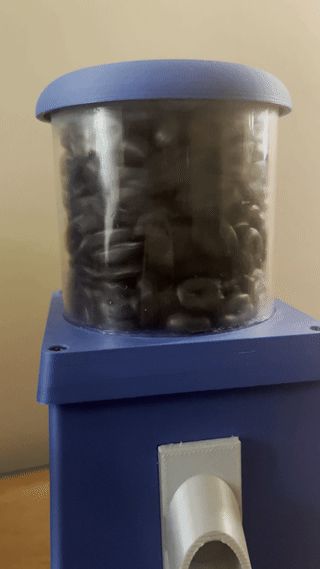
- Press fit the “agitator” (fan/screw) onto the shaft, use a set screw if needed.
- Danger ahead, at your own risk, cut your IKEA 365+ PC bottle with care, use a table saw, mitre saw or multitool, etc. But mind your fingers, this is a round object and it's not going to be as sturdy with the ends cut off. Or use any 65x1-2mm clear plastic tube, an actual acrylic pipe, or thicker PET lemonade bottle, etc. Be creative
- Put the coffee beans in, use plastic ones, because you won't be able to replace them and I don't want to know what happens when fresh ones would go bad.
- Make sure the pipe fits into the grooves, then put the glue in the grooves and insert the pipe. Make sure the agitator is firmly in place because you can't reach it anymore after this step.
License



Comment & Rating (34)