
Magnetic Linear Accelerator + Energy Conversion









Print Profile(2)


Description


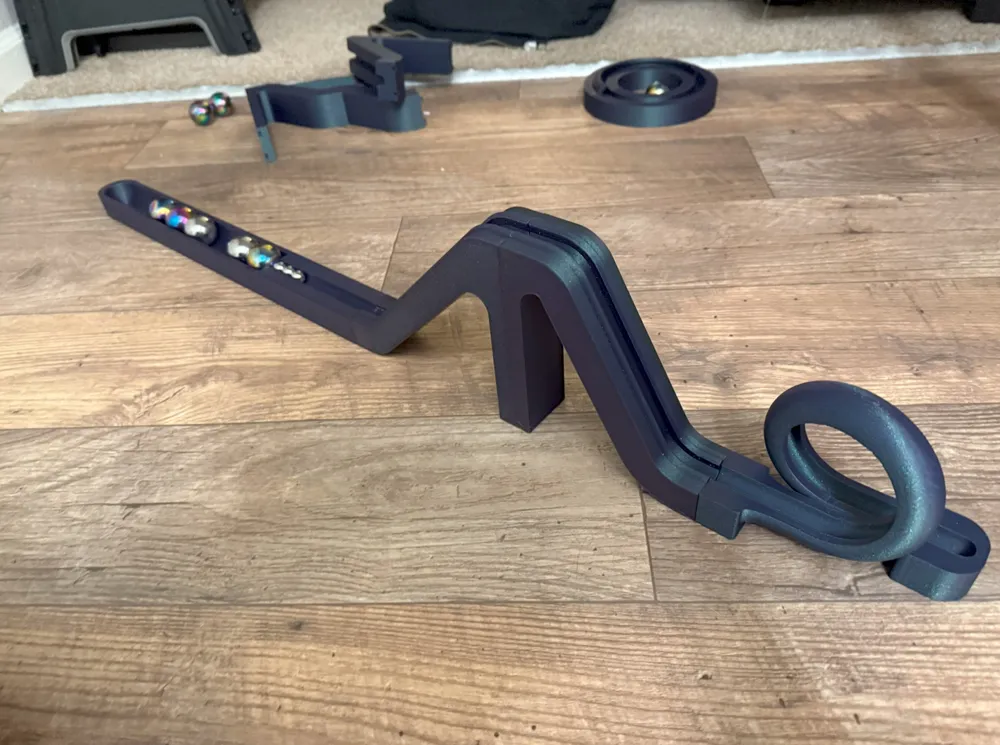
This project demonstrates principles of physics through a magnetic linear accelerator (commonly referred to as a Gauss Gun) coupled with a mechanical energy converter. The design is intended to provide an engaging, hands-on way to explore concepts such as energy transfer, conservation of momentum, kinetic + potential energy, and circular motion. By integrating these concepts into a single apparatus, the project serves as an educational tool to inspire curiosity and deepen understanding of physics.
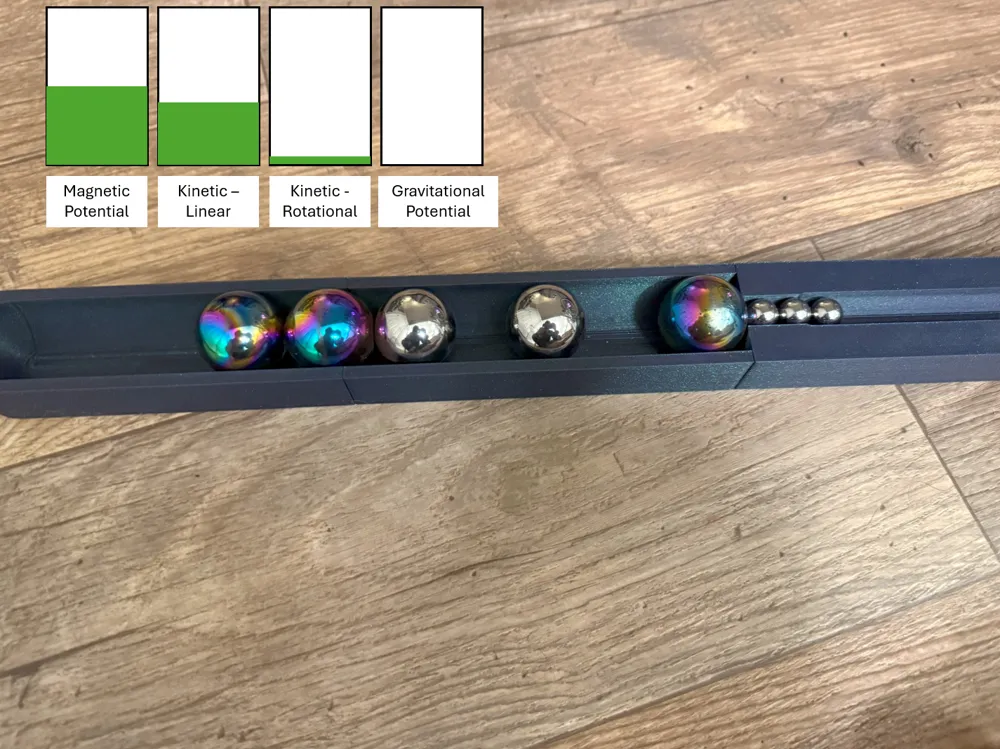
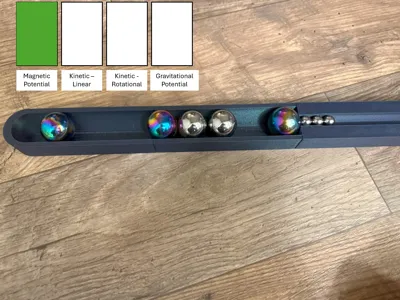
Overview of the Design: The system begins with a straight, flat track that features a sequence of magnetic and non-magnetic ball bearings. The progression and energy transfer are as follows:
- Magnetic Linear Accelerator:
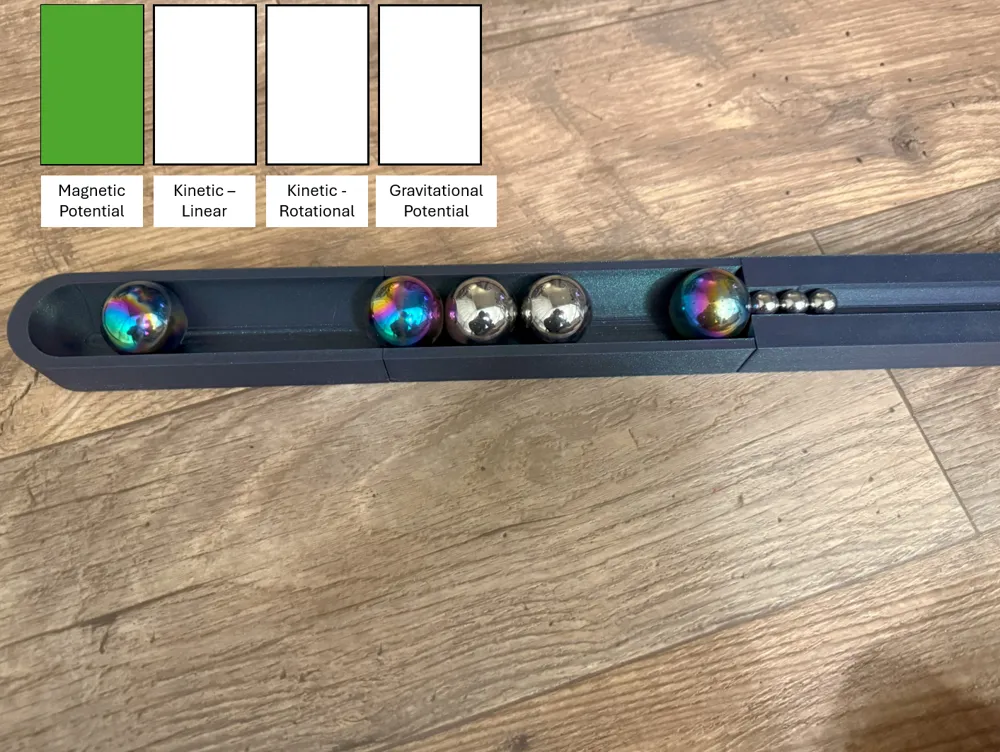
- A 1.26-inch diameter magnetic ball starts at rest on the track. Upon release, it is drawn towards another stationary magnetic ball that is in contact with two 1.25-inch diameter steel ball bearings.
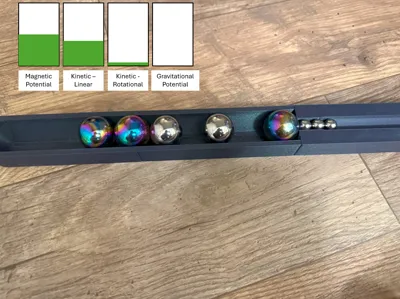
- When the moving magnetic ball collides with the stationary magnetic ball, energy is transferred through the group, causing one of the steel ball bearings to break away and accelerate towards the next stage.
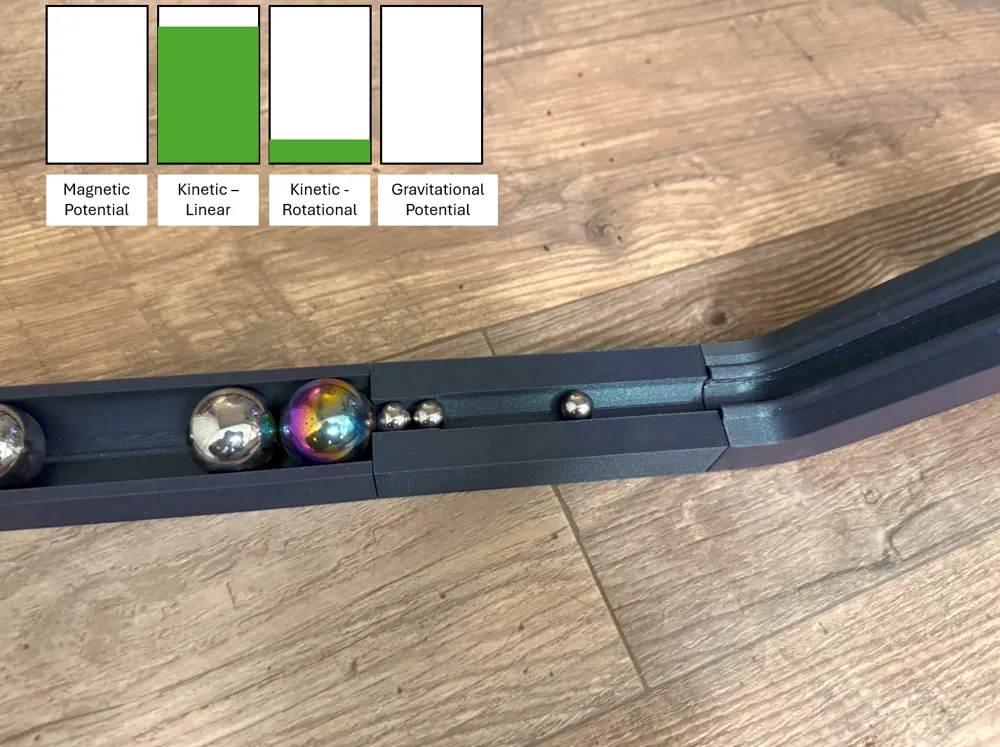
- Energy Cascade:
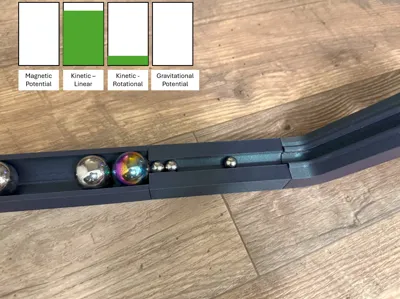
- The first steel ball bearing collides with another magnetic ball (1.26-inch diameter), which is in contact with three smaller steel ball bearings (0.5-inch diameter).
- The collision transfers energy through the group, resulting in one of the smaller steel ball bearings being ejected at high kinetic energy.
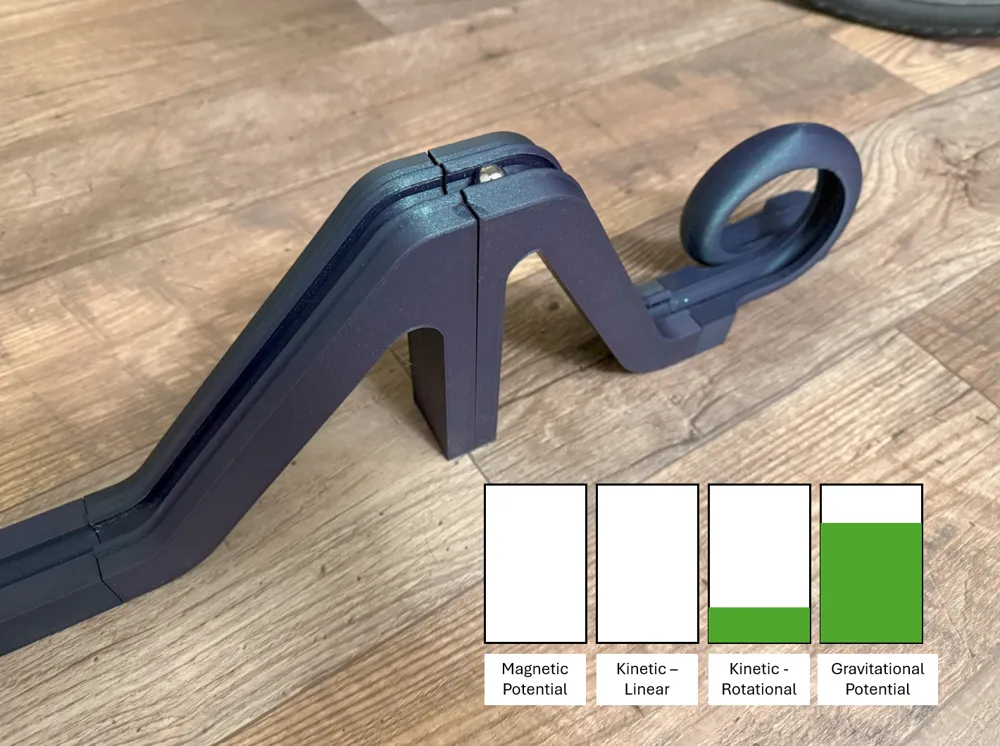
- Mechanical Energy Conversion:
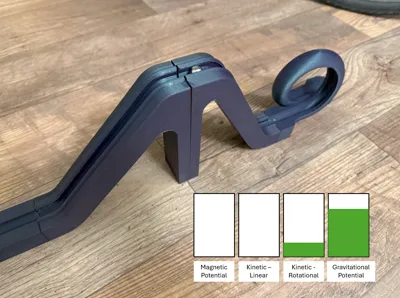
- The high-energy small steel ball bearing ascends a 5-inch ramp set at a 45-degree incline, converting kinetic energy into potential energy.
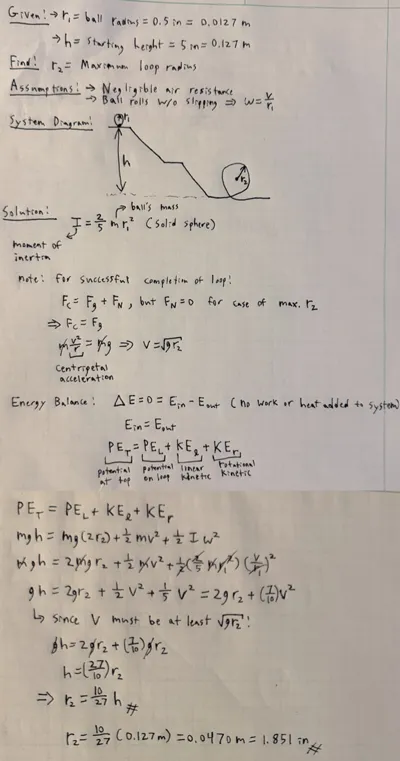
- The ball then descends a 60-degree incline, regaining kinetic energy, before entering a complete loop with a 1.75-inch radius. The loop demonstrates principles of centripetal force and energy conservation.
- Upon completing the loop, the ball finishes the course, providing a clear and visual representation of the energy transformations throughout the system.
Physics Principles Demonstrated:
- Conservation of Momentum: The collisions between the magnetic balls and steel ball bearings demonstrate how momentum is conserved in a closed system. [(m_1)(v_1) + (m_2)(v_2) = (m_f)(v_f)]
- Energy Transfer: The system highlights how potential energy stored in the magnetic balls is converted into kinetic energy, and how that energy is transferred through sequential collisions.
- Kinetic and Potential Energy: The inclined ramp and loop illustrate the interplay between kinetic and potential energy during motion.
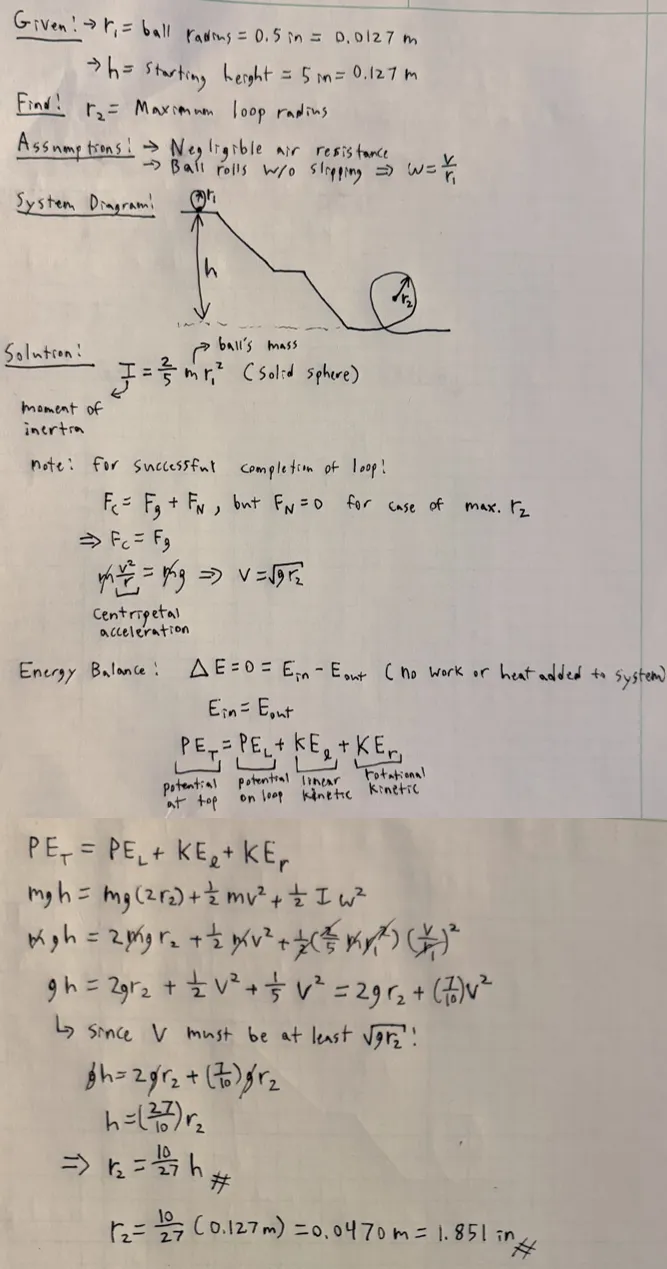
- Circular Motion and Centripetal Force: The loop at the end of the track provides a practical example of the forces required to keep an object in circular motion.
Calculations: See calculation of maximum loop radius for a solid sphere dropped from top of ramp in above photos.
Sources of Error: While the project effectively demonstrates key physics principles, several factors could introduce deviations from the expected behavior:
- Initial Spacing of Magnets and Bearings: Variations in the spacing between magnetic and steel ball bearings can affect the efficiency and predictability of energy transfer.
- Friction: Friction between the ball bearings and the track, as well as between track segments, can result in energy losses, impacting performance.
- Dimensional Assumptions: The loop is three-dimensional, whereas theoretical calculations may assume a simplified two-dimensional representation. This difference can lead to slight discrepancies in performance.
- Material Properties: Variations in the materials or manufacturing of the magnets and bearings, such as inconsistent magnetic strength, can alter system behavior.
- Alignment Issues: Misalignment of the track or bearings could disrupt the smooth transfer of energy.
Addressing these sources of error would improve the accuracy of the system and provide valuable opportunities for further experimentation and learning.
Educational Impact: This project is designed to provide an accessible way to explore fundamental physics principles. By combining magnetism, mechanics, and energy transformations into a single apparatus, it creates a memorable learning experience. Additionally, the modular and scalable design allows educators and students to modify components to test hypotheses and deepen their understanding of the physical world.
Things to Try: Try varying the spacing, order, quantity, and types of magnets and bearings in the Gauss Gun assembly to observe variations that produce the most kinetic energy in the small sphere.
BOM:
- 1.26" Ball Magnet, QTY 3, $7.33 ea., link
- 1.25" Steel Ball Bearing, QTY 2, $4.21 ea., link
- 0.5" Steel Ball Bearing, QTY 3, $0.30 ea., link
- Printing Cost (Bambu Galaxy PLA): 375.02 g, 9h59m, $11.25
Total Cost: $42.56
License

You shall not share, sub-license, sell, rent, host, transfer, or distribute in any way the digital or 3D printed versions of this object, nor any other derivative work of this object in its digital or physical format (including - but not limited to - remixes of this object, and hosting on other digital platforms). The objects may not be used without permission in any way whatsoever in which you charge money, or collect fees.


Comment & Rating (5)